February 19, 2005 - Saturday
| Yesterday started dismally with the
software malfunction that exposed the delicate
underpinnings of my early morning forays into the
blogosphere. Obviously not as exciting as a Super
Bowl malfunction, but still not a good way to
start the day.
Then we had to rush to get Meda to
the Ala Moana Hotel well ahead of a scheduled
conference presentation.
And,
of course, it was the morning a seal decided to
make her appearance on the beach across from
Kaaawa School just as we drove past the spot.
|
|
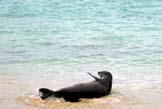 Another
Kaaawa seal sighting
Another
Kaaawa seal sighting
click for larger version
|
I first noticed a government
pickup truck parked on the side of the road and a
few people on the sand looking towards the ocean.
As we passed by, I could see a dark shape right
on the ocean's edge. A rock? A turtle? Possibly,
but with the recent seal sightings in mind I
pulled over. And sure enough, there she was,
rolling languidly in the water and then rollling
over to scratch her back on the sand. At one
point she looked up directly at us, then returned
to her business.
Luckily, I happened to be
carrying one of our cameras and was able to get a
few quick photos before Ms. Seal meandered along
down the coast.
But there were two telephone
messages waiting when we got home last night. It
seems there were two more seal sightings late in
the afternoon in different parts of Kaaawa. What
a day.
Is W telling tall tales?
That's what one alert reader wants to know. She
notes a Reuters
report that President Bush told an audience
of European journalists that he worked on a sheep
farm in Scotland as a 14 year old. But his
experience outside of the U.S. was a point
of contention during the 2000 presidential
election, and a Google search turns up many
references to Bush never leaving the country
before his election as governor of Texas. A
colorful stint as a sheep worker certainly hasn't
come up previously.
Speaking of Reuters, Newspaper
Guild members working in the U.S. for the
London-based company have voted
to strike if necessary to obtain a new
contract to replace the one which expired two
years ago.
Last minute discovery. I thought the laptop had frozen again. Panic. But I noticed a few signs of life, although I couldn't move the cursor and the keyboard was nonresponsive. So I plugged in an external trackball and the cursor moved. And then realized the computer didn't crash yesterday, the keyboared and trackpad were frozen, as they are again right now. Using the external setup, I was able to email this draft page to myself and finish it up on another computer. Now I've got to figure out whether this is caused by a recent software upgrade or is totally hardware related. Not good news, but at least identifying the problem is a huge step forward.
February 18,
2005 - Friday
6:05 a.m.--Powerbook freezes
while waking up from a short "sleep",
taking today's entry down with it. Doom and
despair reigns in Kaaawa. Hopefully all will be
forgiven once the delayed entry finally appears.
And here it comes...
Although then homeland
security secretary Tom Ridge told reporters
during last year's presidential campaign that the
department was above the political fray, in fact
he was meeting with Republican pollsters before
venturing into key battleground states, Associated
Press writer Pete Yost reports.
Yost's article is based on a
review of daily appointment calendars obtained
through use of the federal Freedom of Information
Act.
Unfortunately, it's the kind
of important story that you won't be reading
about any state or county officials in Hawaii as
a result of a ruling last year by the Office of
Information Practices.
OIP
Opinion 2004-17, issued in October, 2004,
held that calendars are akin to personal notes
and therefore are not government records subject
to disclosure. OIP appears to have discounted or
ignored the fact that calendars are maintained by
government employees (secretaries) as a record of
official events participated in by public
officials in the course of their public dutues,
and as such are essential to the operations of
the government. Could any department head operate
without his or her "official" calendar?
Clearly the answer is "No", but that
doesn't appear to have entered into OIP's
considerations.
So the short sad story is that
Hawaii reporters will not be able to check the
veracity of official statements against actual
meeting schedules, at least until someone
convinces OIP to reconsider the issue or takes
the matter directly to court. Sad but true.
Knight
Ridder has stepped up to contribute to the
process of news consolidation by buying the
company that produces a series of tiny community
daily papers in Palo Alto, San Mateo, Redwood
City, and surrounding California cities. The
purchase allows Knight Ridder to scoop up a whole
layer of small advertisers in addition to the
bigger companies that advertise in its premier
dailies like the San Jose Mercury News.
And the battle over the Seattle
newspaper joint operating agreement and the
future of another two newspaper city has reached
the Washington Supreme Court with oral arguments
presented this week.
February 17,
2005 - Thursday
I received several reactions
yesterday to my comments on the Star-Bulletin's
workers compensation editorial. Well, not really
on the editorial but on the issue. Here's one:
I think that you are
right in saying the SB's POV was transparent. But
you didn't address a lot of what was written and
is true. Brian Kanno has refused to meet with
reform advocates for some time. Is that open
government? Is that right? And you cannot deny
that work comp costs in Hawaii are what they are
-- very, very high. I also have personal friends
who are fraud investigators and they tell me that
Hawaii is well known around the country as a
safe-haven for egregious violators of work comp
laws. As for me, when I start my company (some
day) every single employee will be a hired
contractor on a work-for-hire basis precisely b/c
workers comp and other pro-labor provisions make
it harder for small businesses to stay afloat and
remain profitable. Not saying this stuff should
be abolished. But I think that if you went out
and talked to small biz owners about this they
would say that it brakes their growth or, if they
decide to pay it, it jacks up their prices. Just
my two cents.
But on the other hand:
Ian, you are correct
to question worker's comp reform as it is being
presented to an unsuspecting public.
Too many jumped on the
Ahhnold "Governnator" reform bandwagon
here in California, without taking into
consideration the workers that would be left in
limbo until new laws are thoroughly sorted out.
The system was in need
of some fat cutting and specific reform, but what
we have ended up with by pushing legislation
through at a break-neck speed, is a huge mess
that is still being sorted out. The insurance
industry appears to be the eventual big winner,
the injured workers the big losers... no
surprise to myself or others that follow
the screwed-up WC trail.
A quick check turned up
interesting and much fairer discussions of
workers comp issues.
A
2003 article from Risk & Insurance
magazine, co-authored by Phil Denniston of the
Risk Loss Data Institute (cited in the S-B
editorial) contains a chart showing Hawaii as
only modestly above the national average in
workers comp costs for comparable businesses.
Hawaii's system is credited with a favorable
efficiency rating.
A two part series in Insurance
Journal (Oct.
11 & Oct.
25, 2004) assesses Hawaii's rising WC costs
from a more balanced perspective, finding fault
in many areas including the normal insurance
cycle.
In
the first part, a Hawaii insurance executive
explains:
"Examined over a
15 or 20 year timeline, workers' comp costs have
risen at a slower rate than many other business
expenses," he added. "However, because
the insurance cycle consists of periods of
rapidly falling premiums and rapidly increasing
premiums, when premiums are rising the perception
always exists that workers' compensation costs
are out of control.
Other factors cited include
fraud (one exec says premium fraud by employers
exceeds fraud in claims), and the failure of
Hawaii employers to clean up their safety
records.
In any case, these more
balanced discussions of the issues put the
transparent anti-labor bias of the S-B into even
sharper perspective. Assuming that the Bulletin
reflects the views of at least part of the
business community, it's little wonder that key
legislators might view the resulting legislative
agenda as unfairly skewed to the detriment of
employees.
And for something completely
different, I ran across former Advertiser
reporter Bill Kresnak's name and sent off a quick
email. His reply came back with equal speed:
Long time no see.
Been here since 1999 and loving it. Besides
writing about legal-related issues I get to
travel around the country, riding motorcycles and
writing about it. You can check it out at
www.AMADirectlink.com. Take care.
Bill Kresnak
Legal Affairs
Editor
American
Motorcyclist magazine
American
Motorcyclist Association
Friends can reach Bill at bkresnak@ama-cycle.org.
And another reader comments:
"Love the pics of Romeo. I almost like him
as much as Silverman."
February
16, 2005 - Wednesday
The woes of print. The
Advertiser's front page story about the Honolulu
Police Department's web site for stolen property
was hit by those automation gremlins yesterday
morning. The story
by Robbie Dingeman correctly reported the web
address for the police web site, but in the print
edition it fell victim to auto hyphenation which
resulted in an address that wouldn't work if
entered literally. The online version had no
problem.
Yesterday's unsigned
lead editorial in the Star-Bulletin on the
issue of workers compensation legislation again
displayed an anti-labor bias, with name calling
replacing reasoning. It started by calling Sen.
Brian Kanno a "reliable stooge of organized
labor" and never returned to civility.
On the facts presented, the
senate's refusal to move legislation proposed by
the Lingle administration doesn't seem
unreasonable. Although the S-B writer(s) seem to
feel that being forced to obtain medical
treatment from a company-selected doctor is the
epitome of fairness, it's a position not designed
to persuade anyone less then wholly convinced of
their employer's benevolence. And that, my
friends, includes an awful lot of the working
population.
When all is said and done, one
person's "stooge" might instead be seen
as the reliable ally of a clear constituency. Not
a bad position for a legislator to be in, the
views of labor's opponents aside.
Was this, perhaps, a display
of the conservative political bent attributed to
SB owner David Black by other observers?
Speaking of the Star-Bulletin,
put Richard Borreca back on camera! The S-B
sponsored PBS Hawaii program broadcast Monday
night, Island Insights, went downhill this week
with Howard Dicus of Pacific Business News as
moderator with UH Interim President David
McClain as guest. Dicus coasted through the 30
minutes with a series of softball questions that
did little to enlighten or draw out less than
obvious information. Although PBN published a
sharp editorial column about the community
college management fiasco, Dicus failed to even
raise the issue. The current controversy over
classified research? Nothing. Instead, sugar
coating all the way.
Although Borreca has a quiet
approach, he's experienced enough to get past the
introductions and press a hard question. If we're
going to see Dicus again, he needs to learn to do
the same.
And lawyers have announced
their intention to
file suit on behalf of tsunami victims
against a number of parties, including the
Pacific Tsunami Warning Center in Honolulu,
according to a story by Agence France-Presse.
February 15,
2005 - Tuesday
First, news business....Union
members at the Seattle
Times have voted to approve a severance plan
to cover an upcoming round of layoffs, the
newspaper reported today.
And workers in the
third month of a strike against the
Vindicator newspaper in Youngstown, Ohio, are
putting out their own online community
publication, The
Valley Voice.
The Valley Voice is
the official strike publication of Newspaper
Guild-Communications Workers of America Local
34011. We are reporters, photographers, copy
editors, circulation district managers, delivery
drivers and classified advertising sales people
who seek a fair and equitable contract with
Vindicator Printing Co.
A reader spotted this one. Do
a Google
search for "Turtle Bay Resort" and one
of the first contextual ads that shows up along
the side of the page reads, "Turtle
Bay--True Hawaii?" and links to
www.turtlebayboycott.info, a web site for the
Hotel Workers boycott of the North Shore hotel.
The reader comments: "Haven't seen the
unions take it to this level but all's certainly
fair."
If you find yourself feeling
warm and fuzzy about living in Hawaii, here's a
quite unflattering reflection in the eyes of
a transplanted mainlander who sees things
differently:
As for the rest of us,
Mainlanders, whites, "fuckin' haoles,"
we do enjoy the same weather. But we're not
welcome, and we know it. We're reminded every
day, sometimes violently.
It's written to discomfort but
worth reading.
Another
local blog to check out is done by Rob
Schumacher, a Pearl Harbor submariner, who bills
his blog as "A Florida Liberal in King
Kamehameha's Court." He flags a lot of
interesting items from the news, but also boasts
related sites featuring the
family cats, etc. Now you can see how he
caught my attention.
February 14, 2005 -
Monday
PBN has a very insightful column
in the current issue on the accreditation
warning issued to the community college system,
putting the blame squarely on the shoulders of
former UH President Evan Dobelle. PBN calls
Dobelle's community college policy "a
business-school textbook example of what happens
when you try to fix something that's not
broken."
A biting editorial
in today's New York Times blasts President
Bush for what they call "reckless economic
policies" and explains why the Bush budget
proposal is a serious mistake.
Another example of aggressive
sports reporting comes from the Dallas Morning
News, which completed a major investigation into
steroid
use among high school athletes. I haven't
waded through the entire series yet, but it is
quite a read.
A new online publication is
aimed at folks concerned about the academic
life--Insidehighered.com,
a project by several
formers staffers of the Chronicle of Higher
Education.
| After
yesterday's intemperate rant, I should stick to
safer topics like cats. How about Mr. Romeo?
We're
experimenting with the "slow and
steady" approach to introducing him into the
household.
|
 Mr.
Romeo...
Mr.
Romeo...
click for more
|
This involves a series of
gradual confidence building steps, with cat
relations acting just like international
politics. In any case, last week Romeo spent
several days in our bedroom, the idea being that
he could smell the other cats and they could get
accustomed to his smells. Yesterday we kicked it
up a notch and brought Romeo into the house and
let him explore while the other cats were
around.
After an initial loop around
the living room, Romeo sat down with the drugs.
Catnip, that is. Wally immediately exited onto
the back deck and observed from a safe distance.
Toby settled down to watch from across the room.
Harry was asleep. And Duke, settled down on his
currently favorite rug at the door to the back
deck, just hunkered down.
All seemed to go well, except
for a few hisses and some excitement when Harriet
woke up and figured she needed to leap to the
floor and take on the intruder. Combat avoided.
Then, just when I was congratulating us all, some
sort of cat signal was exchanged and Romeo jumped
onto poor Mr. Duke, fur flying. They immediately
broke up when I intervened, which means that it
wasn't all that serious an attack. When it's real
serious, the adrenaline is pumping so furiously
that it's hard to separate fighting cats. That
wasn't happening here. So even though the day's
experiment ended prematurely, I'm not
discouraged.
Anyway, I took a few pictures
of the process, so click on Romeo's photo to
check them out.
February 13,
2005 - Sunday
I was surprised to see Mike
Leidemann's story in yesterday's Honolulu
Advertiser, "Tax
Foundation stands by its numbers on excise-tax
hike".
Apparently it is the
foundation's thinly-veiled response to my
critical comments here on
Thursday and mirrors a long email I received
from foundation president Lowell Kalapa.
Kalapa's reply as restated by
Leidemann reminds me of a button we added to our
collection years ago which was much admired in
academic circles. As I recall, this was the
message:
"I've got charts
and graphs, so f*** off !"
It's meaning: Don't be fooled
by the small stuff.
Kalapa's reply has a bit more
substance, but not that much. He begins by
repeating the mantra that our excise tax is not a
sales tax. That much we can agree on. But then
the sleight of hand begins with a string of
precise numbers and estimates.
There is an excess of
pseudo-precision in the foundation's estimates.
We're told that this statistically average family
will have to pay $907.20 more as a result of the
proposed excise tax increase. That extra seven
dollars and twenty cents--count them, 20 pennies,
not 19 or 21--lends an aura of authority to the
number. Is the foundation's methodology really
capable of such precise calculations, including
that important 20 cents tacked on to the $907?
The short answer is clearly "no". It's
a claim that would be laughable if made directly.
But using such specific numbers is part of the
illusion of authority.
I'm not an economist and don't
claim to be. Of course, neither is Kalapa. And
although I enjoy him on a personal level, I'm
skeptical when it comes to the foundation's
economic assertions and political message.
When I look at arguments like
this, I try to look for some outside validity
rather than simply internal consistency. So
instead of relying on the figures presented at
the end of the Advertiser story, I'm looking for
other independent evidence of what the numbers
might mean.
After all, key pieces of the
Tax Foundations' theory, like the "tax
base", are not real things, but rather are
constructs used by economists to explain and
predict the behavior of the economy. Is it fair
to refer to them as if we can spot them the same
way in everyday life? Maybe not.
The foundation starts with
"Arnie Aloha" and family, presented as
a statistically average family with an adjusted
gross income of $82,840 a year.
The federal Bureau
of Labor Statistics, however, puts the income
before taxes of the average Honolulu household at
$56,000, with annual expenditures of $43,448,
substantially less than the foundation's Arnie
Aloha.
The foundation then describes
the impact of a transit tax based on their theory
of how much this average family already pays in
excise taxes, direct or indirect.
I'll try it another way. If
the excise tax has such a dramatic hidden impact,
it must be visible in lots of other ways. How
about costs and prices? So let's check out
comparable costs in Portland, Oregon, which
doesn't have an excise tax or sales tax.
According to the Tax Foundation's theory, the
amount we're paying in hidden excise taxes should
be reflected in much higher costs.
The same set of data from the
Bureau of Labor Statistics compares expenditures
in a number of western cities, including Honolulu
with our excise tax and Portland without any
similar tax. The BLS data show Portland and
Honolulu are almost exactly, with very similar
expenditures. It's hard to see evidence there of
any huge impact of our "compounding"
excise tax on family expenditures.
I've gone on too long already,
a result of having too much time on a lazy Sunday
morning. Does this mean the Tax Foundation is
wrong? Not necessarily. But it does, in my view,
mean that the Tax Foundation's data, economic models,
and opinions should not be uncritically swallowed
by reporters in single source stories on
controversial issues. There's a lot of room for
disagreement under the surface of those charts
and graphs.
| Meanwhile, to
counteract the adrenaline started by the tax
argument, here are the best pictures from our
early morning walks during the month of January.
Sunrise on the beach is a good way to start the
day. Click on the photo for the January
batch. |
|
Previous
week • Other