|
July 16, 2005 - Saturday
After reading several newspaper accounts of Arizona Senator John Kyl's report attacking the constitutionality of the Akaka bill, I realized none noted that the report was prepared and distributed by the right-wing "Grassroot Institute of Hawaii". The author, attorney Bruce Fein, has identified himself as attorney for the Grassroot Institute. Earlier this year, Fein published a column saying it is President Bush's duty to pack the Supreme Court with ideological conservatives, "philosophical clones of Justices Antonin Scalia and Clarence Thomas and defeated nominee Robert H. Bork." Scary stuff, but useful to know. A bit of context always goes a long way.
But what a strange bunch of bedfellows the Akaka bill has created. On the one hand, there's the folks like the Grassroot Institute and its president, Richard Rowland, who is almost a caricature of the frothing mainland haole conservative transplant to the islands. Then paddling in the same anti-Akaka canoe are the Hawaiian utopians holding out for the mythical freedoms promised by the second-coming of sovereignty. Their odd alliance with the far right must pain this group, most with high principles, years of activist experience, and many coming from the far left of the political spectrum. Their motivating vision, which pits an abstract quest for "independence" against Akaka's practical approach to politics, seems akin to some mix of "Jesus coming soon", "The South shall rise again", and the ghost dance movement.
Oh, I can't believe that I said that, but sometimes it just seems a very weird world.
July 15, 2005 - Friday
Public access media advocate Sean McLaughlin was ousted from his position as president and CEO of Akaku: Maui Community Television by a close 8-7 vote during a board of directors meeting on Wednesday night. The deciding vote was cast by newly appointed director Charlie Jencks, a land developer who had been part of a move during the last legislative session to gut the organization's funding. That effort, spearheaded by developer Everett Dowling, was widely believed to have been motivated by anger over the use of Akaku's broadcast facilities by community organizations opposing key development projects.
Jencks was appointed less than a week before. The letter making the appointment is dated last Friday, July 8, and signed by Department of Commerce and Consumer Affairs Director Mark Recktenwald.
In the letter, Recktenwald says Jencks was selected "at Akaku's request", although McLaughlin later said there is no public record of Akaku's board making such a request.
In a written statement distributed yesterday, McLaughlin said:
"I am saddened and disappointed over the Board's decision yesterday to terminate my employment as president & CEO of Akaku: Maui Community TV. Unfortunately, the Board's decision was politically motivated and in violation of state and federal laws.
I will be seeking legal counsel to evaluate my options."
McLaughlin is credited with building Akaku's strong county-wide broadcast presence and national reputation for excellence, but has been at odds with state cable regulators for several years over their failure to strictly enforce compliance with prior agreements involving Oceanic Cable, which now holds a statewide monopoly on cable service.
| I had fun with one of my recent Kaaawa photographs, converting it to black & white for a poster (both large and small versions), and using a color version for a computer mouse pad. Just click on this photo to check it out. |
|
| And for those wondering where the cats have been this week, I can say that they're here, active, and relatively happy. I think we had at least four cats in bed with us over night, not a record but cozy nonetheless. Anyway, here are a few more photos. Just click on Mr. Leo for more. |
 Mr. Leo
|
July14, 2005 - Thursday
I had quite an interesting reply yesterday from Ed Greaney, adding more historical perspective to the excise tax discussion. He wrote:
Ian, your economic instincts vis-a-vis Hawaii's excise tax are valid. It does, indeed, go back to the '30's (when the rate was much less).
My father worked with an economist from the Brookings Institution as advisors to the Territorial Legislature when the excise tax originally was crafted. The Brookings man and Dad may have been naive but their position was that the excise tax was a cost of business item to be largely absorbed rather than directly passed on to the consumer.
This didn't sit well with retailers, and there was a debate in the business community whether to abandon it in favor of an outright sales tax during the late '40's.
In the late '40's you had the odd situation of the Honolulu Chamber of Commerce taking two separate and diametrically opposed views in testimony before the Legislature. The Retail Board (headed by Art Jones of the Liberty House stores) pushed for a sales tax. The Chamber's Tax Study Committee (headed by my dad and staffed by Nolle Smith Sr.) supported the excise tax as being less regressive than a sales tax. The ILWU took the same position as the Chamber.
In June of 1950 my dad died. By then Nolle Smith had left Hawaii and went on to a distinguished political career in the Caribbean and to become a major African American figure of his day. Roy Brown took his place at the Chamber. The Tax Study Committee (forerunner of today's Tax Foundation of Hawaii) fell into line with the Retail Board to urge a sales tax. Fortunately, this view didn't prevail at the Legislature, although the gross excise tax has grown to be identified as an individual transactional levy in the business food chain.
It sounds like digging through old newspaper microfilms and legislative records might turn up an interesting bit of detail about this period, when the excise tax was viewed as a less regressive alternative to a sales tax. Today the popular perception, at least, is exactly the opposite.
Former Star-Bulletin webmaster Blaine Fergerstrom has joined the world of blogging with "Blaine's blog". Perhaps it should simply be "Blaine's world". Of course, I enjoyed his July 13 description of the old "ahem" messages I used to receive from George Steele. Anyhow, check it out. Now that he's got a blog, he needs some readers.
| Another bit of 60's trivia, the initial issues of Honoluolu's underground rag, The Roach. Here's Volume 1, Number 1 of The Roach, dated May 13, 1968. Followed by Volume 1, Number 2, dated June 4, 1968. Covers were printed on colored stock, and the newsprint is aged and yellowed, making the scan results less than pristine. But it's the content that counts.
Number 1 features an ad urging members of the Hawaii National Guard to refuse to be activated for duty in Vietnam and encourages resistance.
Number 2 reports on the occpation of Bachman Hall at UH, along with the Fort DeRussy sit-in. I was surprised to see myself in the center of one of the photos, fiddling with my camera as I captured my own photographs of the demonstration and arrests.
|
|
|
|
July 13, 2005 - Wednesday
I had a couple of very different replies to yesterday's comments about transit and the general excise tax.
Here's the first:
I don’t know if the general populace realizes how significant an achievement it is for Mufi to have negotiated this compromise. It makes me feel good that we have a mayor who is not only willing but able to insert himself in a situation like this and create a solution.
Can you imagine Harris doing the same? Nah. Me neither.
Fair enough.
But then Russell Yamashita weighed in:
See attached testimony submitted on behalf of the neigbor island accountants who see the new Honolulu Excise Tax as economically devastating to small businesses and residents outside of Oahu. May be you should take an Economics 101 course again to figure it out.
The primary issue cited in the testimony concerns fear that costs will be passed through from Honolulu-based suppliers to neighbor island businesses even if those counties do not impose the additional transit-specific tax.
I queried whether the lower rate applied to wholesale transactions would lessen that perceived burden. Yamashita replied:
Duh? The wholesalers and retailers who provide goods and services to the neighbor island businesses and residents will pay the 4.5% for all the gasoline, rents, overhead, etc. and pass those costs to them. Ergo, all costs incurred on Oahu will be rolled in to the cost of goods and services, it ain't simply no 0.5% being added. Wholesale prices will hide the impact on those items being resold, but things like professional services, delivery costs, and the like will have a direct line impact on the neighbor islands bills.
Think of the old cartoon about the snowball rolling down a snow covered mountain, by the time it gets to the bottom its a boulder. Same concept with the Excise Tax, verry interestingg!!
But just as I was starting to gear up for an argument, he played the cat card:
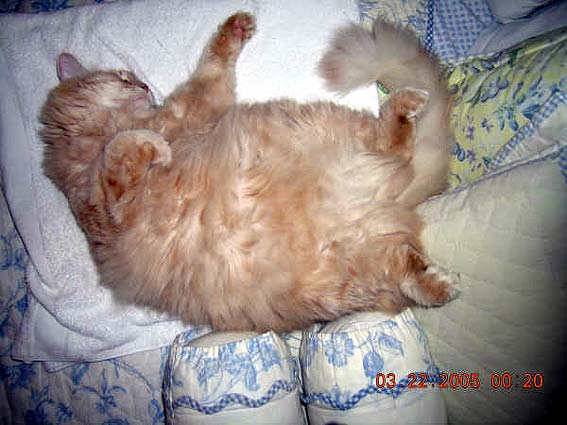
"The Excise Tax serves as value added tax to a large degree, though not quite the same mechanics. My cats kibble will go up at least 3 to 5 cents a can. See attached photo."
|
|
It's hard to argue in the presence of such an obviously happy cat!
My own feeling is that the argument about compounding is that it addresses the general excise tax as a whole and is not really a specific argument about the incremental increase to fund transit.
A couple of things strike me. First, the argument about the snowballing impact of the GET has been considered and apparently found less than pursuasive in the past. For example, the 2001-2003 Tax Review Commission paid for a study of the GET which concludes that while it needs to be periodically tweaked to reduce its impact on business-to-business transactions, the overall structure isn't bad. (Here's the full commission report, and just scroll down to select the excise tax study).
The second thing that occurs to me is that the "sky is falling" rhetoric about the half-cent increase in the GET bringing down the economy is just overblown and not productive in furthering a reasonable argument. After all, Hawaii has had the largest tax cut in history in the past several years with the decrease in personal income tax rates, and most people didn't notice it much one way or the other.
And if you caught the Island Insights show this week on economic matters. Paul Brewbaker noted that despite all the doom and gloom talk from some quarters, Hawaii as a state has enjoyed quite an unusually long stretch of economic growth going back decades, despite a compounding GET that has been in place since the 1930's.
And it also hit me that the multiplier effect calculations pointed to by opponents were done prior to quite a few changes in tax laws to reduce the business compounding, or so the Tax Review Commission study suggests. So those calculations of how much the half-cent will "actually" cost an average family may be way out of date.
Ah, an interesting set of issues, isn't it?
July 12, 2005 - Tuesday
5 a.m. and the electricity just went out, but came back on in about ten seconds. I'm crossing my fingers that it stays on for a while.
The last minute deal avoiding a veto of the so-called transit tax bill has to be a big boost for Mayor Mufi Hannemann, who has pushed it strongly while other politicians have waivered. With the exception of Cliff Slater, there really haven't been any rail opponents, just tax opponents who see this particular tax as a target of opportunity. But unlike most taxes, whose intended uses include a mixed bag of unspecified public goods and services, we know where this particular tax is going to go, and the public and our repressentatives can judge whether this particular use is worth the extra half a cent on the dollar.
Actually, to counter the "largest tax increase in Hawaii history" argument, rail backers might consider a "what this half penny will buy" campaign to convey the long-term benefits of a completed rail system.
And, yes, I am a supporter of the social engineering aspects of a rail system, which will encourage population growth along the rail corridor, in effect lessening development pressures that might otherwise be targeting us here in Koolauloa.
Meanwhile, Bob Jones notes:
in case you missed it in your media checks tonight ....
kitv at 6 p.m. led with two package reports on small brushfires on the leeward coast. a reader on all the brush fire reported today. a voice-over on some stabbing at ala moana center, and a voice over on the death LAST NIGHT of a mepod rider.
then 6 minutes into the newscast they carried the story of the compromise that restores the transit tax.
some news station, eh?
Howard Kurtz, in his Media News column in today's Washington Post, reviews press reactions to Karl Roves current woes. The Post also has the transcript of the White House press briefing during which questions centered on Rove's role in the leak, also available at the White House web site.
Well, it's too late for me, but the Wall Street Journal reports that newspapers are now more interested in the potential of reporters' blogs.
Not too late for me, it seems that Hunter Thompson's remains will indeed be shot from a cannon, according to the Denver Post.
And, just for fun, don't miss this parody of hurricane coverage. It's a hoot.
July 11, 2005 - Monday
Fast work. Noted Honolulu attorney David Schutter died yesterday afternoon, and the Advertiser features its obituary in today's paper.
And speaking of the Advertiser, one reader noted:
At 8:10pm - 80 degrees and partly sunny (according to the weather bug in the upper left corner of the Adv home page)
But They DID put "back issues" back!
Yes, the back issues are back, this time right there at the top on the left side of the Advertiser's main page.
I missed this when it came out a few days ago, but Knight Ridder took a good look at the pros and cons of our options in Iraq, none of them very good.
The New York Times has a detailed account today of Time reporter Matt Cooper's decision to testify about a confidential source, adding to Newsweek's report on what Karl Rove told Cooper.
| The Washington Post reports today on the myriad of ways that we collectively spend some $34.4 billion annually on our pets. For additional perspective, search Google News for something like "doggie day care" and you'll find reports from across the country. This stuff is big business for a bunch of small businesses.
Anyway, here are a few more photos of our Kaaawa dogs, including Yeats, a handsome German Shepard who recently moved in with his people. Just click on his photo....
|
 Yeats
Yeats
|
July 10, 2005 - Sunday
| It's Sunday, still cloudy after a bit of rain yesterday and overnight. Actually, Saturday was pretty much gray and damp all day, requiring us to deploy umbrellas during at least part of the morning walk. But when the sun caught the clouds as they passed over the far side of Kaaawa Valley, the drizzle didn't matter. |
|
Recommended: NPR's look back at Airplane!, the movie that created a genre, after 25 years. Even if you haven't seen it at least 25 times (as we probably have), NPR's review is worthwhile.
| And here's the next installment of the history of dissent in Hawaii, photos from the 1976 "Hawaii Walk for Disarmament and Social Justice" which again focused on the presence of nuclear weapons at Pearl Harbor's West Loch. In this photo, UH political science professor Oliver Lee carries a sign linking the military and land development. Just click on the photo for more. |
|
Previous week • Other
Search this site,
courtesy of the folks at Atomz.com
|
Visit the
iLind Online Store
for cards, posters, & more
RSS newsfeed


Please don't hotlink to photos or reuse without permission


|