|
February 7, 2004 - Saturday
| It's been cloudy, wet and threatening for several days out here in Kaaawa. Not the weather known for wonderful sunrises. But we've managed to avoid being rained out and have walked as usual each morning, only to get some great sunrise moments like this one, despite the rain. Or perhaps because of the rain. Take your choice. |
 Rain & dawn--Kaaawa
Click for larger photo
|
I awoke this morning to find an email from Ian Yonge, the historian of my family roots in England, following his receipt of a packet of old letters from my sister, Bonnie:
I recently received from Bonnie a collection of letters written to my great great great grandfather in New Zealand. they passed to your mother in the 1950s and then to Bonnie and then to me. They are a real treasure .
One dated 1879 refers to troubles in Afghanistan and need to teach them a lesson. Nothing changes! Well some things do I hope. We sent an army there in the 19th century and only one man came back to British India to tell the tale
It also refers to the damage electricity will have on the fortunes of the gas companies.
Somewhat along the same lines, I ran into articles about that periods war in Iraq while I was paging through the Maui News from 1941 looking for any clues about the silly Maui Kennel Club trophy that we recently brought home.
From a friend in BC comes this column, "Canadians to Bush: Hope you lose, eh".
If you're interested in the shape of patronage, it's interesting to browse through the directory of boards and commissions available via Gov. Lingle's web site.
If, like me, you didn't make it to Murphy's for the gathering in honor of Dave Donnelly, be sure to check out yesterday's Star-Bulletin report.
February 6, 2004 - Friday
The Hawaii Supreme Court, faced with the unpleasant and very rare task of disciplining a member of the judicial fraternity, apparently did what it could to lessen the pain for all involved--it delayed final action for more than three months and finally quietly issued a one paragraph legal order just days before Christmas, virtually insuring that the news would be lost in midst of holiday celebrations.
At 8:37 a.m. on Monday morning, December 22, 2003, the Court's unusual "Order of Public Censure" against retired District Court judge David L. Fong was filed.
The censure order cited Fong's failure to "fully disclose his wife's many and various financial, fiduciary, and ownership interests, or acquisitions and transfers of such interests" in several of hostess bars. In addition, the court found that Fong "was at least aware of alleged criminal activity at a property owned by his wife" and, as a result of his conduct, "cast his judicial office into disrepute."
I've got a special interest in the matter because the 3-1/2 year process leading up to the censure was triggered by my reporting in mid-2000 that detailed Fong's complex ties to hostess bars in the Kapiolani-Keeaumoku area and his apparent failure to fully disclose those business interests in the annual financial disclosures required of judges and other public officials.
Although both the Star-Bulletin and Advertiser carried brief stories about the censure on Christmas Eve, the holiday timing of the court's action apparently did not leave the opportunity to inspect the extensive investigative record which became public when the order was filed. This file includes copies of correspondence, the long list of original charges proposed by the Office of Disciplinary Counsel, several additional investigative memos, a long recitation of facts stipulated to by Judge Fong, and the Commission on Judical Conduct's final recommendations for discipline. I scanned these two documents to make them more widely available.
The documents show that the Supreme Court's order was originally issued on August 14, 2003, along with a notice giving Judge Fong 20 days in which to dispute the findings and recommendation. On September 2, Fong's attorneys filed a written statement indicating they would not have any exceptions to the recommendation. The Supreme Court then apparently delayed filing of the order, which would put the matter on the public record, until December 22, 2003.
The record makes clear that Judge Fong withdrew his application to be reappointed to another full term only after receiving the Disciplinary Counsel's lengthy set of allegations, and after a series of meetings with ODC attorneys in August 2002, first with Fong and then with the Judge and his attorneys. After reviewing the charges, Fong withdrew his application for retention and instead announced his retirement.
Before reaching a stipulation agreement with Fong, ODC spelled out other matters "for potential future investigation." High on their list were admitted misleading or false statements:
“Special counsel is concerned over the accuracy of the various representations made by Ms Fong and/or her attorneys in cases filed on her behalf. Judge Fong has stated that the pleadings in the New Pacific and Sun Kyu matters are essentially false.”
“Given the seeming lack of veracity in New Pacific and Sun Kyu, Special Counsel is also concerned about statements made in other cases….”
“The circumstances surrounding these potential misrepresentations, particularly Judge Fong’s connection to them, if any, have yet to be fully investigated.”
The disciplinary counsel also cited potential conflicts of interest as matters for future investigation:
“Special Counsel notes that just about every transaction described in the Statement of Allegations that was handled by Judge Fong carried the potential for conflict of interest. Judge Fong at one time or another represented nearly every business in matters ranging from incorporation, acquisition of licenses, and lease matters, even where those transactions involved another client (either former or present) and/or his wife, Ms. Fong. Such conduct raises concern under Hawaii Rule of Professional Conduct 1.7. A judge’s violation of the HRPC, during periods when the judge did not have full-tiime duties, is ground for judicial discipline. The Commission may wish to investigate whether representation of each client was proper and free from conflict of interest, or if any conflicts were properly disclosed and consent of the clients obtained.
In any case, the investigative file is a rich store of documentation of judicial misconduct which never became "news" because it was buried by the Supreme Court's apparently carefully timed public release during the holidays. And that's a comment on both the Judiciary and the media.
February 5, 2004 - Thursday
The National Security Archives, a project that focuses on declassified documents, has quite a useful introduction to American policy toward Iraq during the Reagan years as it shifted towards Saddam Husein's regime. I wish I had seen this when it was first published nearly a year ago.
And if you're in a learning mood, spend some time browsing in MIT's new OpenCourseWare initiative, which is making hundreds of academic classes available for free via the Internet, with more coming. The site says there are now 500 courses online to select from.
From the U.S. Naval Observatory:
Sun and Moon Data for One Day
The following information is provided for Kaaawa, Honolulu County, Hawaii (longitude W157.8, latitude N21.6):
Thursday
5 February 2004 Hawaii-Aleutian Standard Time
SUN
Begin civil twilight 6:45 a.m.
Sunrise 7:08 a.m.
Sun transit 12:45 p.m.
Sunset 6:23 p.m.
End civil twilight 6:47 p.m.
MOON
Moonrise 5:10 p.m. on preceding day
Moon transit 12:06 a.m.
Moonset 6:58 a.m.
Moonrise 6:08 p.m.
Moonset 7:40 a.m. on following day
Full Moon on 5 February 2004 at 10:47 p.m. (Hawaii-Aleutian Standard Time).
That's just to give a flavor of the pace of our day here in Kaaawa. I overslept this morning and don't have as much time as usual to ponder this entry. So sorry.
It took me a day and a half to negotiate the security changes in the UH mail system so that Meda could get to her campus email. Turns out that the instructions posted at UH didn't work. Eventually I was able to find some troubleshooting advice on the University of California technical support site that solved the problem. Too bad UH left many Mac users twisting in the wind during this big change.
February 4, 2004 - Wednesday
It's raining hard again in Kaaawa this early a.m.
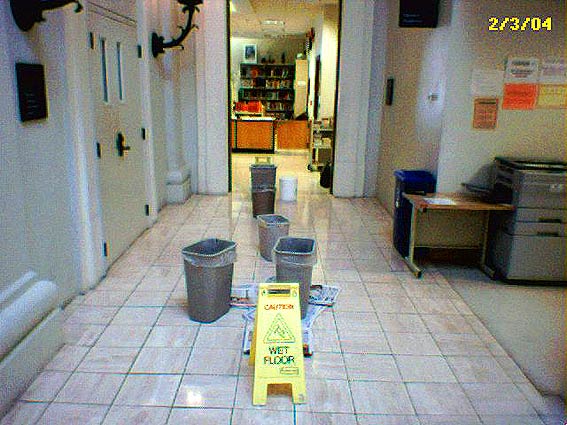
| I made a quick stop at the State Library downtown yesterday morning to check for an old newspaper clipping. Arrayed across the floor along the front end of the Hawaii-Pacific section were waste baskets and newspapers to catch rain leaking through the roof. If it's leaking here, is it leaking in areas where books and equipment are at risk? |
 |
There's an interesting Nicholas Kristof column in today's New York Times which compares the Bush budget fantasy with the debt crisis in Latin America back in the 1980's. Some harsh words there.
Did I get carried away the last couple of days? A reader or two thought so and let me know it in no nonsense language. I'll have to digest those messages before replying.
But my basic point about the reporting of this recent labor issue is pretty simple. If a newspaper were reporting on a significant court case, one expected to hit the front pages and reverberate politically, it would certainly refer to the substance of the decision and would not simply rely on quotes from the "losing" party. That would immediately be recognized as unfair and less than accurate reporting. Shouldn't those same standards be applied to the reporting of significant labor decisions which are also sure to make the front pages and spawn public debate? Fair reporting wouldn't resolve the public debate, but it would better inform it. Simple point, perhaps over-elaborated here.
February 3, 2004 - Tuesday
Editorials by both Honolulu dailies have compounded their biased reporting on the use of arbitration in public employee contract disputes.
Yesterday the Advertiser sided with Gov. Lingle and took an editorial stance against binding arbitration.
According to the Advertiser's editorial:
Today, arbitrators aren't obliged to consider the state's overall financial condition or the fact that when one union wins a raise, the other public unions feel equally deserving.
Actually, state law (§89-11(f) HRS) spells out what factors have to be considered by an arbitration panel. Contrary to the Advertiser's assertion, among the factors presently set by law are the ability of the employer to afford a settlement and the state's overall financial condition.
89-11-(f) An arbitration panel in reaching its decision shall give weight to the following factors and shall include in its written report or decision an explanation of how the factors were taken into account:
(1) The lawful authority of the employer, including the ability of the employer to use special funds only for authorized purposes or under specific circumstances because of limitations imposed by federal or state laws or county ordinances, as the case may be;
(2) Stipulations of the parties;
(3) The interests and welfare of the public;
(4) The financial ability of the employer to meet these costs; provided that the employer's ability to fund cost items shall not be predicated on the premise that the employer may increase or impose new taxes, fees, or charges, or develop other sources of revenues;
(5) The present and future general economic condition of the counties and the State;
(6) Comparison of wages, hours, and conditions of employment of the employees involved in the arbitration proceeding with the wages, hours, and conditions of employment of other persons performing similar services, and of other state and county employees in Hawaii;
(7) The average consumer prices for goods or services, commonly known as the cost of living;
(8) The overall compensation presently received by the employees, including direct wage compensation, vacation, holidays and excused time, insurance and pensions, medical and hospitalization benefits, the continuity and stability of employment, and all other benefits received;
(9) Changes in any of the foregoing circumstances during the pendency of the arbitration proceedings; and
(10) Such other factors, not confined to the foregoing, which are normally or traditionally taken into consideration in the determination of wages, hours, and conditions of employment through voluntary collective bargaining, mediation, arbitration, or otherwise between the parties, in the public service or in private employment.
And the arbitrators didn't ignore the impact on subsequent negotiations with other unions.
"With respect to the Employer's argument that the arbitration panel should take into consideration the impact this award may have on subsequent negotiations involving other bargaining units, there are a host of factors that may affect the bargaining posture of the parties including but not limited to the size of a particular unit, the ability to pay of a single employer versus multiple employers, the ability to tap outside sources to fund wage increases, and personnel shortages. Special consideration may also be given to units which are comprised of employees who are primarily engaged in providing essential services that are critical to ensuring public health and safety."
The arbitrators noted that these UPW workers included correctional officers, emergency medical "first responders", and certain nurses and nursing assistants.
And if there were proper reporting in the first place on the decisions of arbitration panels, there would be more public appreciation for how these matters are in fact addressed in the deliberations.
The Advertiser was not alone in this stance. The Star-Bulletin stepped out onto the same thin ice in an editorial two weeks ago.
I can't help wondering whether the editorial writers and the public would have been so ready to criticize the 5 percent per year raises granted emergency medical workers, nurses, prison guards and other members of Unit 10 if stories on the arbitration award had noted that the current salaries are well behind those of public employees on the west coast doing the same work? In some cases, according to data cited by the arbitration panel, Hawaii workers lag their west coast counterparts by as much as 65 percent when our higher cost of living is taken into account. Although that gap isn't typical, substantial disparities exist across the range of jobs. Better reporting of those data might have conveyed a very different public impression of the arbitration award.
While so publicly mourning the deaths and praising the sacrifices of two paramedics lost in this week's plane crash on the Big Island, the news media should honor these public employees by at least fairly reporting union efforts to narrow the wage gap with comparable workers on the west coast and in Hawaii.
February 2, 2004 - Monday
Are Honolulu's daily newspapers biased against organized labor?
I've heard that criticism for years and, in the past, have rallied to the defense of the newspapers because, in my experience, it's rare to run into a reporter who is just flat out against unions.
But Bill Puette, director of UH's Center for Labor Education and Research, made some telling points in a recent panel discussion and, as a result, I've been trying to pay more attention to coverage of labor issues.
Here's a recent example. In the middle of last month, both newspapers reported on an arbitration panel's decision to grant raises of 5% a year to members of UPW Unit 10, made up of correctional officers, emergency medical personnel, nurses, and nurses assistants.
The Advertiser story quotes Gov. Lingle and state chief negotiator Ted Hong. The Star-Bulletin also quoted Lingle and Hong, along with city spokeswoman Carol Costa. Both papers got quotes referring to the cost of the decision. These reports appeared as Lingle's move to eliminate binding arbitration has been getting considerable attention.
Neither story quoted a labor source or even indicated that they had sought comment from a union perspective. Even more telling, in my view, is the failure of either paper to draw anything from the lengthy decision and order by arbitration panel members Russell Higa, Lawrence Ishimi , and Roy Yamamoto.
I stopped by the office of the Hawaii Labor Relations Board on Friday and picked up a copy of the 41-page decision. The HLRB office is on the 4th floor of the state building at the corner of Punchbowl and Halekauwila, just a block up from the Star-Bulletin's Restaurant Row newsroom and a couple of long blocks from the Advertiser.
It was definitely worth the trip, as the decision includes the dense legal and economic reasoning behind the arbitration panel's final award to this UPW unit.
> Compared to employees doing similar work in several west coast states, prison guards make 42.3 percent to 63 percent less than their mainland counterparts (when cost of living is taken into account), and Hawaii compensation lags in other categories as well.
> AFSCME researcher Michael Messina testified that compensation of "full time government employees in the State of Hawaii ranked 21st among the fifty states in 1993, dropped to 31st in 1998, and fell to 36th in 2001, behind all of the west coast states...."
> Arbitrators rejected the employers' argument that a 20-year old amendment to the collective bargaining law prohibits comparisons to mainland wages in this type of proceeding. The arbitrators' found that state and country representatives used mainland comparisons in other cases as recently as earlier in 2003 when they appeared to support the employers' position, undercutting their own legal argument in this UPW case.
> None of the state's witnesses "testified expressly that the employer was unable to pay for the Union's proposed wage increases".
> Economists testifying on behalf of the union noted considerable evidence of improved economic conditions, including conclusions of the state's Council on Revenues as well as bond rating agencies and other indicators such as hotel occupancy rates.
> The arbitrators rejected as "excessive and therefore unreasonable" the union's position, which called for about a 7 percent across the board wage increase as well as "step movements" on the wage scale estimated to cost an additional $6.1 million.
> And the arbitrators agreed that the union's use of Comprehensive Annual Financial Reports (CAFR's) prepared by the Department of Accounting and General Services to determine the state's economic situation was more reasonable than using budget figures. The panel found "that CAFR's are audited and give a more precise depiction of the State's actual finances and are therefore more useful than the budgetary tools relied upon by the Employer which are more reflective of budget priorities."
There is a lot of important and newsworthy material here, information which would increase the public's understanding of the arbitration process and the details that guide the decisions. There's lots here to call into question Gov. Lingle's cursory rejection of the arbitration process as not serving the public interest and, accordingly, this is precisely the type of information the public needs to become familiar with.
So why is it so rare for the actual contents of these labor arbitration decisions to make it into news reports, even when political reactions to the decisions are played up as big news? That's the key question, and I don't have the answer.
It's clear, though, that the stories cited above ran despite lacking any semblance of fair comment from the union perspective, and there's no sign that editors at either newspaper were concerned about failure to present any of the actual contents of the decision being reported. These are cause for concern. Whatever the factors involved, the result is, at minimum, the appearance of bias against labor.
February 1, 2004 - Sunday
I'm still puzzling over Gov. Lingle's call during her 'state of the state' speech for a balanced budget amendment to the State Constitution.
As Richard Borreca reported the next day, the Constitution already contains provisions which require a balanced budget. These requirements are found in Article 7, Sections 5-9 of the Constitution.
The accompanying legal commentary notes:
Although express words "balanced budget" are not included in state constitution or statutes relating to state budget, constitutional and statutory provisions do require a balanced budget by requiring a description of proposed expenditures and sources of revenue to pay for them. Att. Gen. Op. 97-1.
Lingle's speech explicitly called for cooperation and an end to partisanship while at the same time introducing an implicit partisan challenge of her own by claiming the politically charged "balanced budget" position and ignoring the constitution's existing provisions requiring a de facto balanced budget, provisions passed by a previous Democratic legislature before being approved by the voters.
She managed similar moves throughout the speech, for example assailing partisanship while slipping in the reference to "40 years of one-party rule". All skillfully done, no doubt.
| I should have known that you just can't let your guard down with nine cats sharing our space.
I looked away from my lunch for just a few seconds yesterday and there was Ms. Annie helping herself to a bite or two. And standing on the plate as well, just to rub it in.
|

Ms. Annie makes her move |
Previous week • Other
Search this site,
courtesy of the folks at
|




|