|
|
|
|
|
|
|
|
Previous week • Other date • About iLind.net • Search • Contact us |
|
|
|||
The power went out in Kaaawa about 5:20 a.m., just as I was sitting down at the computer for this morning's entry. So it's a bit delayed courtesy of Hawaiian Electric.We do seem to lose electricity here in Kaaawa more frequently than most other parts of the island. I often marvel at how outages in Waikiki or Kahala actually become news, with reports in the daily papers describing how long power was out, how many homes plunged into darkness, and the soothing words of hardworking HECO flacks on how soon power will be restored. But there's no news value in loss of power in Kaaawa, where the news would probably be power staying on without a flicker for a reasonable period of time.
Our power must go out once a week. Often it happens when we're out, but the flashing VCR and kitchen appliances testify to the outage. We usually just hope it doesn't happen while we're cooking. That's the worst, not knowing whether to abandon all hope or simply hunker down and plan on a late meal.
Actually, this morning's outage wasn't bad. I didn't have anything to write about anyway, and it provided an excuse for an extra 40 minutes in bed.
[Late note] Kamehameha Highway, our sole route for getting to Kaneohe and into Honolulu, is closed this morning. Two police cars with lights flashing are turning cars back just at the far end of Kaaawa. When they turned a city bus around, we knew it was bad. People coming back say an accident overnight knocked down a pole, which is now blocking the road while crews work to get a new pole in place. There are a lot of unhappy folks looking at turning around and going home, or driving an extra hour around through Haleiwa to get into Honolulu. The road is expected to remain closed until 10 or 11 a.m. Luckily just we're going to sit here and enjoy a pot of Peet's coffee.
Road closed:
Traffic being turned back towards KaaawaMy weird find yesterday was this nugget from aviation site AVWeb.com dating back to last September, describing a Honolulu man's purchase of a Russian SST--on eBay. No mention of whether or not the plane has been moved to Honolulu.
A business with both money and a desire for the unusual was the top bidder for a Russian SST on eBay last week. Yes, you read it right, in amongst the porcelain knickknacks and heaven-only-knows-what-all-else was a genuine Tu-144LL, the last flyable Russian SST. A determined buyer known only as "hihold" was the sole bidder from $2,300,300 to $2,500,000, which is the point he finally met the seller's reserve and the plane became his. For his $2.5 mil, hihold, one Clifford Laughton, the CEO of a new start-up airline called Premier International Airways, will get the aircraft and will pay the costs of having the fuel-guzzling bird flown from the Gromov Flight Test Center in Moscow to his location. An IL-76 Russian transport aircraft will follow the Tu-144 to the buyer's closest Port of Entry and once on the ground, Tupolev mechanics will remove the SST's engines and take them back -- they're the property of the Russian Air Force and not part of the deal. This particular Tu-144 flew in 27 missions as part of the NASA-Boeing-Tupolev High Speed research program and has TTAF of 434 hours/28 minutes. The Tu-144 is a plane that feels the need for speed. The aircraft can reach Mach 2 within 10 minutes after takeoff, and its top speed is Mach 2.35. Though speed was why the Tu-144 was built, Laughton tells AVweb he bought the plane for advertising and promotion, and it should be good for both.A year before, Laughton made news with his purchase of 31 units in Executive Center previously owned by a company controlled by Sukamto Sia. And, no, these weren't listed on eBay.
Getting a lot of attention yesterday--Jim Romenesko's MediaNews column's highlight of a review of a new book of media criticism by a pair of Washington Post editors. The review, from ThePhoenix.com (Boston), jumped on the criticism of corporate journalism like that fine-tuned by Gannett, and now taking over the other large chains of corporate newspapers.Co-author Robert Kaiser, a former Post managing editor, is quoted: "You and I could spend the afternoon drawing up a business plan to turn the Gannett newspapers in a different direction and have them try to sell quality in their communities. But they don't have the people to do that. I genuinely believe that, if I live long enough, I will see the Gannett corporation fail."
On the other hand, an article in SmartMoney.com this week is touting Gannett stock on the theory that local advertising is holding up better than large national advertisers, and that Gannett's chain of papers, most with effective monopolies in smaller cities, should buoy the corporation's stock price.
Shareholder value vs. journalistic value. That's the battle, and we're all prisoners of the war.
It's been a week of heavy morning clouds that largely blocked the morning sun in Kaaawa. I didn't take any photos a couple of mornings, which is usual, and the remaining dawn was subtle at best.
But the sun is beginning its period of rapid movement, rising earlier each day. We're already able to push our departure time for the morning walk about 10 minutes earlier than a the beginning of the month. Soon we won't be able to keep up with the sun.
Lizzie's still hanging out down the hill and across the street. I try to get her home at least once ever 24 hours. The problem now is that the other cats are picking on her, which means she's got to remain on guard during her indoor periods, which isn't fun. We need a cat shrink, I think. Or a new aumakua.
Local Macintosh users were angered by a brief Advertiser story announcing Tuesday night's meeting of the Hawaii Macintosh and Apple Users Society (HMAUS), which featured a program about the new flat screen iMac. The story spent three paragraphs providing information on the meeting, including time, place and subject matter. The fourth and final paragraph included the only person quoted, an officer in a local PC company (PC as in Microsoft, direct rival of Apple) who spoke dismissively about his competitor's new product offering.Letters have been coming in to the HMAUS email forum for several days, although most have focused on the SuperGeeks exec rather than the Advertiser's selection of his quote. Here's a sample from an HMAUS member spending the year in Holland:
Did you notice the slur the paper (Advertiser) printed along with the story? Why do they feel thay have to do that? Look at the comment this guy makes.. What an idiot!! Maybe some of you guys could call them on this.. I am in Holland and it makes me mad...If you're into purple prose, check out the newly online Hawaii Reporter, the creation of ex-PBN writers Malia Zimmerman and Jay McWilliams which has finally gone public after a long gestation period. So far, the writing is mainly Zimmerman's ultra-opinionated prose, featuring a column of tidbits gathered daily at the Capitol, along with a generous serving of general news from United Press International.
The site strikes me as a bit of an odd start, overreaching in the direction of tart and hasty rather than thorough and thoughtful, but, knowing the folks involved, it's going to be interesting to see how it develops.
Perhaps it's time to admit it. We took advantage of an air fare sale and spent the long weekend in Redwood City, on the San Francisco Peninsula, visiting Meda's mother and two sisters. Here's a plug for local Internet provider, Flex.com. I was able to maintain contact via a local dial-up number provided along with a regular Flex account, which is already about the least expensive in Honolulu. If you don't need technical support (which is what Flex has eliminated to make low rates possible), Flex is a great deal.Anyway...The newspaper front was marked by the appearance of free daily tabloid newspapers with versions for many of the Peninsula cities--Burlingame, San Mateo, Redwood City, Palo Alto, etc. The Daily News , which started in Palo Alto, now has a small chain of papers which have won awards in their local competitions. There's also a Daily Journal, which covers other communities.
The free daily papers I saw were about 24 pages, with some local news, lots of wire copy, and lots of small ads for local businesses. Distribution was free and copies were readily available in public places, stores and restaurants. The Palo Alto paper put out a weekend edition as well.
I don't know how the economics work on these free dailies, but it would certainly be interesting to analyze.
The Chronicle and Examiner were competing with the San Jose Mercury News throughout the Peninsula, and the going rate for daily papers was 25 cents.
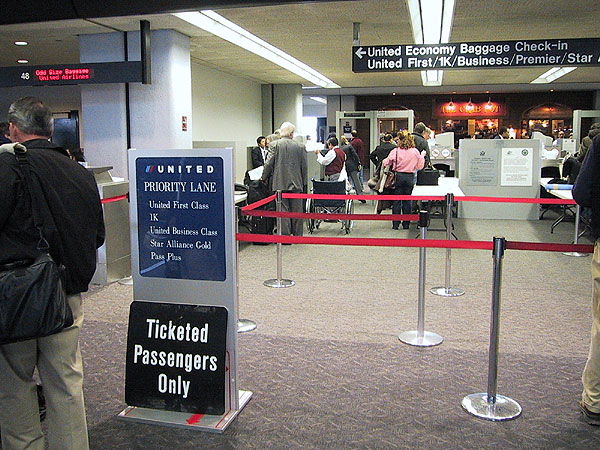
We also saw the the latest element in flying's class structure--special First Class security lines at United in San Francisco. The "regular" security lines were snaking through the lobby, but there didn't appear to be any line at all at this First Class entry. I don't think anything similar exists here in Honolulu. Perhaps it's because SF is a United hub.
When we got home late Monday afternoon, we discovered that little Ms. Lizzie had made a daring Sunday escape by knocking out the screen and breaking a couple of jalousies, and making one large leap for freedom from the window above our garage. We had decided to keep her inside during this short trip because of her recent pattern of disappearing for long periods. Apparently she didn't agree with this plan and made her own arrangements.
She went out the window on the far right. In the larger version of the photo, you can just make out the missing louvers.
Of course, our cat sitter couldn't find Lizzie, and she didn't show up when we got home, either. We spent the night and most of yesterday morning not knowing whether she had been injured in the fall. But about midmorning I walked down to her new hideout again, and she finally responded to my calls. A quick check showed she was just fine, thank you. So I left her there, returning late in the afternoon to retrieve her. Would she come home if I just left her out and let her get really hungry? Probably. Will I just let her stay out on her own schedule? Probably not, although after her escape artist routine I'm not sure what the alternatives are.
But she was here when I got up this morning. Right now, she's perched high on a light valance in the kitchen, sort of in the middle of my hanging Treasure Craft. She ate for about 3 cats last night, and doesn't appear to be in any hurry to disappear this a.m.
Yesterday's entry brought this quick retort:I don't understand how putting two or three papers in the racks mean the Star Bulletin is selling more papers! You had a person say they saw the truck pull away with only a couple papers in the rack, that also happen to me at 6 am Thursday. Two papers in the rack, and the Advertiser rack had been filled prior to that (so the getting out earlier statement is also wrong). You should not blow your own horn, especially when the facts don't back you up.The problem here is that this reader appears to be looking at this single rack and projecting out to overall S-B distribution and sales. Reporters often make the same mistake, assuming that a particular case reveals the whole issue. The observations yesterday were apparently based on an overview of the Bulletin's distribution system. It's current philosophy appears to be "just enough papers to cover sales", which leaves nothing extra for show. The claim--perhaps still to be tested--is that if a rack actually sells out, the number of copies distributed there will be relatively quickly increased to meet "demand".
Of course, there are a lot of almost random variables. There's more news some days, leading to jumps in sales. Some papers are laid out better to grab attention, some headlines draw more reaction. All of these impact those single copy sales. So it must take a complex formula to predict how many sales to expect in each location while trying to minimize the expense of returns.
I'm trying to be relatively objective in looking for the "facts" of the situation. All observations or comments that shed light on this are appreciated.
A friend at the Star-Bulletin added a few comments on the issue of distribution in street boxes and store displays for single issue sales. He says a revised distribution plan gets Star-Bulletin's out into the racks before the Advertiser, beating the competition by about an hour on most mornings. "Needless to say, it has helped sales," he says.If there appear to be fewer copies of the S-B on some racks, it's true, but it's the result of tighter controls and fewer returns of unsold papers. With the new distribution system in place, it's possible that a particular box can sell out of papers, but rapid adjustments mean that it's unlikely to happen two weeks in a row. All these changes are contributing to gradually rising street sales, at least according to this one source.
I suppose we won't really know until the circulation audits are published later this year.
Burl Burlingame advanced the Kailua newspaper war story with a photo of a sign posted inside the little Kalapawai Market explaining why the Advertiser is no longer being sold inside the story. Click here for the sign.
Sunday morning. I've already gotten one "ahem...where's the morning read?" message soon after dragging my body, and, slowly, my brain, out of bed in the middle of this three day weekend.In the morning mail, this message:
It's true about the Tizer hawker outside Kalapawai Market near Kailua Beach. I've seen him each morning when I drive by. Never seen him sell a paper though.And from the SETI@home team:
Congratulations on recently completing your 1,000th SETI@home workunit. Through your support, SETI@home has grown to become the largest distributed computation on Earth. We at SETI@home greatly appreciate the 1.83 years of computer time you have donated to the project, and hope that you will continue your support. As a small token of our appreciation, you may now download and print an official certificate stating your achievement of this goal.I haven't downloaded the certificate yet. And I haven't figured out why I've remained part of the Star-Bulletin's SETI group, contributing my computer hours to the Bulletin's account. Retaining some link, I suppose, with my friends in the newsroom. And I notice Blaine's still got his name there as well, so it must be ok.
Late Friday afternoon, Hawaii Legislators were informed that Internet access at the Capitol, including incoming and outgoing email, would be shut down for the long weekend.The move also shut down public access to the Legislature's web site, along with access to the text and status of bills. This shutdown comes as the legislative session hits a major deadline for forwarding bills to the other house, so that public interest in bill status is at its highest.
Senator Les Ihara, Jr. protested in an email to House and Senate Clerks, although it makes me wonder whether the email was delivered before the shutdown went into effect.
Les wrote:
I believe that this action is unacceptable because it would eliminate public access to legislative information (bill status, text, etc) at a critical time when many stakeholders need the information to decide immediate actions they need to take on legislation they are tracking.I am also concerned being informed at such a late date about the legislative website shutdown, after most legislators have gone home. Also, why was the public not notified of this unprecedented action? There must be a way to maintain public access to important legislative documents, rather than simply cutting off access this weekend, and I hope you can find a way to do this.
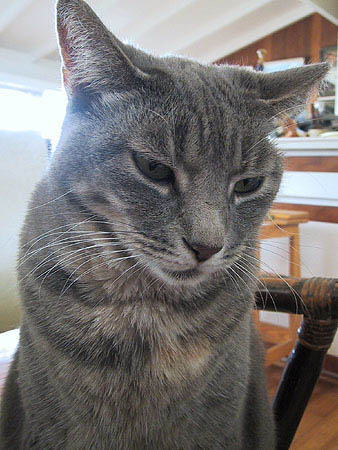
And at home in Kaaawa, Ms. Wally is still in the process of enforcing her claim on the title of Queen of the Whole Shebang. This involves stalking through the territory, glaring at the other cats if they are not sufficiently deferential, threatening to take over any and all favored sleeping spots, and demanding the right to turn each door into a revolving door. Now she wants out. Oops, now she wants back in. But only for a minute or so. Then out again. It's her way of making sure that we understand Ms. Wally's status as well as the other cats do.
But with all that said, she's a very sweet cat who knows that she likes human laps and isn't afraid to ask for what she wants.
Ms. Wally
Search this site,
courtesy of the folks at e
\*/.