|
|
|
|
|
|
|
|
Previous week • Other date • About iLind.net • Search • Contact us |
|
|
|||
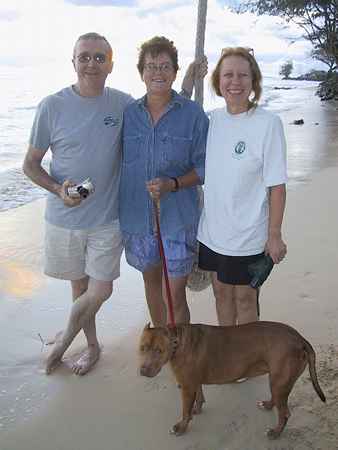
Top o' the morning to you. Greetings & aloha to new friends in Ireland! This photo is by special request of our canine friend, Maile, and her person, Mari, who we saw on the beach last week with a visitor from Ireland. He's Mari's brother in law, Pat, and was on his way to Australia with a stop to greet the new year in Kaaawa.
In any case, Pat wanted family and friends in Dublin to know that he's doing fine, and enjoying the beaches of the Pacific. We can attest to that.
Pat Bigold will be surprised to hear that my great-grandfather, Robert William Cathcart, made his way to Hawaii from an area which, I'm told, is just south of Belfast. He eventually married several different Hawaiian women, leaving parallel Cathcart families in the islands.
The Greyhound delivered us down to Seattle last night safely and ahead of schedule. So from Kaaawa to Ireland by way of Seattle, here's the photo.
Greetings to Ireland!
Click for larger photo
Too bad. Still no clue as to why my Zio! compact flash reader isn't being recognized by my iBook. The last-minute upgrade to the latest operating system version was supposed to clear up all these problems. No such luck. Reinstalling the Zio! driver also brought no relief. Neither did serious wishing...I really wish this would work. But, so it goes. No reader, no photos. At least not for now.This grim view of the news from neighbor Bob in Kaaawa, swept from the web:
The paper of record in Ireland, the Irish Times, announced recently that losses for 2001 would reach $2.3 million and rise to $20 million this year.In Germany, Axel Springer Verlag AG, which publishes the conservative dailies Bild and Die Welt, expects to report losses for 2001, after stagnant earnings in recent years.
In Italy, the powerful leftist daily, L'Unita, crushed by debt, was forced to suspend publication in 2000, though it has since reappeared.
So we're just part of that big, global picture of media organizations hitting the economic wall. What that means for us in Hawaii remains a mystery.
This quote attributed to Martin Luther King (1963) was emailed by a friend, and seems an appropriate comment on affairs of the day: "Nothing in the world is more dangerous than sincere ignorance and conscientious stupidity."
And this reaction came in response to the short story in the current Honolulu Weekly on the superseding indictments against United Public Workers chief Gary Rodrigues and one of his daughters.
Great job---on explaining the indictments. Given that this investigation could go in any number of directions or in all directions at once, I would think that there are some legislators sweating bullets over this. Especially, people who were most probably recipients (along with other democratic candidates) of campaign contributions streaming out of health fund overpayments to public unions. The fact that monies were shuffled through Royal State where Russell Okata is a Board Member and HGEA has intimate ties moves the spot light of Federal scrutiny on that action as well. If this case goes to trial, there will be a lot of important nervous people wondering just how much the Feds know and how much more might be revealed through testimony. I would think that there might be great external pressures on Rodrigues to plea bargain his situation from others than the Fed.As a big "D" Democrat, the potential for anti-labor forces to grab ahold of and push such an investigation for their own purposes is certainly worrying. But as Democrat, and a union member concerned about internal union democracy and labor corruption, the best way to avoid political damage is to shoulder the responsibility of cleaning up the mess. Whether or not Rodrigues if found guilty of criminal violations, it's clear that the pattern of financial transactions were contrary to the interests of his union and the rest of AFSCME and the AFL-CIO. It seems to me that it's time for labor to clean its own house rather than to imply that the labor movement endorses theft from its members. Perhaps I shouldn't offer up such thoughts, but it all seems so obvious.
You see what two days without sun will do to one's brain?
From home, this message about the new queen of the feline universe:
Wally wanted a little extra attention tonight. She was on railing of the front lanai and I went to say goodnight. I ended up on the stairs with her rolling around in my lap the way I've seen cats rolling around on the ground. For what I guess was about 10-15 minutes, she was a bundle of squirming cat, walking around me, in my lap, even nuzzling me. Obviously she misses you (as do the others). So, I assured her that you were just off on a trip and would return soon.
I would like to say "it wasn't my fault!"But I can't, at least not with a straight face.
So I'll blame the lateness of today's entry on my troubled relationship with Technology. I love these toys. I played for hours getting ready for this trip, but that required (?) updating software and other things that one should never do before setting out for the arctic. Or the mainland. After cramming to get ready, I hoped it would all work as dreamed when I popped open the computer and hooked up that cable. And, of course, almost nothing worked as I expected. Actually, almost nothing worked, period. I'm slowly working myself out of that mess. But no photos (it won't recognize the compact flash reader) and everything's late.
In any case, greetings from the land of $1.19 premium gasoline, low-rise buildings, and less-than-balmy rain: beautiful downtown Mount Vernon. Washington State. Walking in the rain turned up four thrift stores (all visited in rapid order), the latest in corporate fast food, a 24-hour Safeway next to the Wal-Mart, lots of state social services offices, and mucho traffic.
I can also report that I didn't have to take off my shoes for security screening at Honolulu Airport. The United concourse at SFO seemed unusually empty. And a late night in Mount Vernon is anything after 9 p.m.
I already miss the cats and it's been less than 36 hours ("Hello, Lizzie. Are you reading this? Be a good kitty!").
Hey, the rain's stopped. Think I'll go check out the Wal-Mart. Update my appreciation of American culture.
There was a bit of excitement Monday morning when the trucks carrying the film crew rolled into Kaaawa before 6 a.m. Traffic was stopped at various points as a staging area was set up at former state rep Reb Bellinger's yard, and filming started at Kaaawa School as well as along the beach. The movie--something called "Surfer Girl," if we read it right.
Lots more blond kids were on the set than normally seen in Kaaawa, that much was clear.
OK, sports fans. I'm off this morning for another quick mainland trip, this time to the Seattle area. If technology cooperates, I'll post daily, although I can't promise what time of day I'll get to it. And, of course, I'm famous for losing these battles of mobile technology. We'll see.
You can help. Now's the time to send in your comments, observations, and rants. Anything to fill this page while I'm on the road. I'm counting on you, friends.
Hawaii.com, the Internet site now being jointly developed and marketed by Gannett & Donrey Media, still includes the Star-Bulletin in its list of Hawaii news media. I wonder whether that's going to last? The site still reflects Donrey's original content, along with some new glitches. Using the prominent "Jump to More Information" menu just got me an error message. It's going to be interesting to see how this site develops.There were some unhappy people yesterday who missed the Jan. 6 cutoff of the latest airline fare sale. West coast fares popped from the $300 range on Sunday to over $500 yesterday. We managed to get in just under the wire and book a brief mainland jaunt, but ran into others who didn't act in time.
Former islander Matt Uiagalelei thinks we need to go another round on the conflict of interest issue.
Ian seems to think that the appearance of a conflict undermines the profession and "confuses" viewers. Don't you think that this is an outdated position that assumes that viewers need (or want) to be protected?News is a commodity and *caveat emptor* reigns. If, as a viewer, you are too stupid or lazy to find out what is or isn't a paid advertisement, if you can't employ critical skills to your consumption of news, if you don't know who owns the news outlet you are using, or, especially on an island, if you are unaware of who is obligated to whom, then you deserve to be confused and misled.
There seems to be this prevailing nostalgia about the good old days when news was so pure and unadulterated by commerce. Check out a copy of the New York Times or the Los Angeles Times (or especially The Advertiser) from the turn of the 20th century. News today is far more fair *because* big conglomerates own news outlets that are at least subject to the rules of the free market, rather than the dictatorship of Otis Chandler or Lorrin Thurston.
Relying on professionals to present pristine, value-free, unbiased reporting is an unrealistic and unworkable ideal that will hopefully stay in the 20th century where it belongs. Paula Akana and Malia Mattoch were representing the families of dead people in the context of only those deaths. In both cases, the anchors, who report under news directors and station managers and share holders, did not hide their affinities. They did not try to "operate behind the scenes" as Ian suggested as an option. I would be far more frightened of a situation where an anchor acted as a defacto spokesperson through someone else.
Well said, Matt. Would anyone like to take the bait and continue the discussion further?
When we drove up to the house last night, Kili was the first cat to come running at the sound of the car. Leo was second, coming from a different direction. I came up the stairs and into the house looking for Silverman. I'm still very anxious, both about his safety and his willingness to return after being confined for a week against his will. I didn't immediately see him and was worried, then came back out of the kitchen and there he was, sleeping on the remains of a cardboard box which we've left out as a cat bed. All the other cats showed up within minutes. Silverman starred when the food came, serving as the cleanup guy. He's the one who moves from one cat dish to another, cleaning up any leftover morsels. Then he moved to the dining table, where he begged for a bit more before collapsing into a post-banquet stupor.
Yesterday's delay was my own fault. Today's was a problem with the server at HostRocket.com, which was "down for maintenance", as they politely say. Sorry for the delay.I surprised myself this morning by starting to feel very sorry for Honolulu Mayor Jeremy Harris, prompting a longer diatribe on campaign issues than you probably want to read.
The feeling was triggered by reading Johnny Brannon's account in this morning's Advertiser of Harris' latest skirmish with the Campaign Spending Commission. Harris says his campaign is being singled out. I don't know about that, but it does seem to me that the Commission and its director are simply wrong on this issue.
I've been following the work of the Campaign Spending Commission since January 1983 when I first signed onto the staff of Common Cause. I can say from long experience that this isn't the first time they've taken positions that were off base. It's partly a product of the piecemeal way in which the state's election law has been put together, one bit at a time. If you don't know the history, it's hard to understand how the commission can get so tied up in ridiculous knots.
The issue Brannon describes stems from a 1997 advisory opinion issued by the commission. The brief version: the law sets a limit of $6,000 on contributions to a candidate running for governor with the four-year period between elections. And in this opinion, the commission goes further and says that $6,000 limit includes any contributions to the same candidate, even if he/she runs for another office during the same 4-year period. When applied to Harris, it means that anyone who contributed to his last campaign for mayor has to deduct those previous contributions from the amount allowed for the governors race, effectively crippling Harris' fundraising from major donors in this campaign for governor.
Even a cursory look at the legislative history shows that there was no intent to cut off the possibility of fundraising for legitimate campaigns. Here's a bit of the hidden history.
The law used to limit contributions "per election". A couple of creative campaigns for candidates holding major 4-year offices then argued that they could take in additional money by accepting the maximum allowed by law for the elections held in the middle of their terms even though they weren't running in that election.
For example, at that time a contributor could give a maximum of $4,000 to the mayor or governor's campaigns ($2,000 for the primary and another $2,000 for the general election). Using the "per election" loophole, the creative types effectively doubled those limits by hitting up large donors for $4,000 during those mid-term elections. The commission did move to disallow those extra contributions, but then sought to amend the law to eliminate the confusion. That led to the current statute, which dropped the "per election" provision in favor of the "election period" for the office being sought. The commission then takes this very literally and without regard for the fact that in many situations a candidate might legally be in more than one election during a four-year period.
Harris also seems to have a legitimate beef with the commission's decision to impose fines until the campaign provides identifying information for each and every contributor. I would bet that not a single major campaign has successfully identified every contributor. Sometimes it just can't be done. Federal law requires that the same information be gathered by candidates for federal office, but recognizes that it may not be possible, and requires only that a campaign make its best effort to comply. Certainly the Campaign Spending Commission should similarly recognize the "best effort".
Enough campaign opinion.
We relented yesterday and, with more than a little trepidation, let Mr. Silverman out of the house. He'd been kept in for a week and had been very good about it, but he was very anxious to get out the door.
He turned out to be quite good about it, at least during day #1 of freedom. He came back in several times during the day. Hopefully he'll do the same today. Then we'll have to decide whether to continue with the gradual move towards more inside time.
Meanwhile, he remains a very handsome cat, as you can see in this picture, taken during one of this swings through the house yesterday.
Silverman
OK, I don't know how I screwed today's entry all up. It was done on time this morning. BTW. Before the walk. And I thought I uploaded it properly. No such luck. A few minutes ago--12 hours later--someone finally emailed to ask "where's Sunday?"I bit of sleuthing and I have to unfortunately admit that I screwed up. It happens. But here's the morning entry, just a bit delayed.
I got up around 3 a.m., closed Silverman up in the bedroom we've been using as a cat recovery ward, and opened the cat door, letting the other seven cats decide whether they wanted to stick around or head into the outdoors. By the time I dragged out of bed shortly after 5, most had apparently taken the invitation. I've seen Miki, the senior cat, here in the living room. Lindsey came once to the front door to scratch the screen and then dance out of reach. And Wally may still be in the bed. The others have all gone walkabout.
But it looks like a nice morning weather wise, a repeat of yesterday's fine weather.
I received a couple of responses to the conflict of interest issue raised again yesterday.
One was unsympathetic.
"And I'm looking not for a textbook response on ethical conduct--'conflict of interest' in lieu of an exegesis is meaningless", he wrote.I believe that people who phrase a question in such a way as to disallow its answer are just looking for a way to move the line. Why do you need an exegesis (and, yes, I had to look it up) when "conflict of interest" says it all? Send this guy to the library to read up on the history of journalism. He needs a refresher course on how and why codes of conduct end up as "textbook".
But the next write took a broader perspective in this rant on the state of contemporary journalism.
If a journalist works for a medium which relies on advertising for revenue, that journalist is involved, at least indirectly, in a conflict of interest.Decades ago, the boundary between advertising and news was more distinct. Decades ago, reporters were left to cover their beats unmolested by editors, except in small markets.
Nowadays, most news coverage is editor-driven. It's not because the editors have better news judgment. It's because the editors are compelled by management to consider the relationship between advertising and news. That's the main reason for the industrywide shift from "news" to "information." Information doesn't threaten advertisers, and it's not likely to attract a lawsuit which could affect the bottom line adversely.
Maybe it's a coincidence, but the swallowing of independent news providers by media conglomerates seemed to switch into high gear after Vietnam and Watergate. It seems plausible that the consensus among the business-political establishment was: "We can't outlaw the media, but we can buy the media." And did they ever.
The honest truth is, and I don't intend to be provocative, but simply honest: Show me a journalist who works for a paycheck which is funded by advertising, and I'll show you someone would like to be a journalist.
I am one. It took me years to realize it. It's time for all of us, or most of us, to realize it.
And to ask ourselves, and each other, "How do we set things right? Where do we go from here?"
Great statement of the dilemma. Of course, I'm left wondering about the writer's reaction to the mini-conflict that prompted this discussion, but that's another story.
Finally, another reader recommended Andie Tucher's column on the future of journalism from the Columbia Journalism Review.
"I was riveted; perhaps you/your readers will be as well."
Search this site,
courtesy of the folks at e
\*/.