|
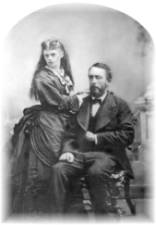
A Narrative by Bonnie Stevens This document is a work in progress. While basic facts have been documented, some family traditions have not. We are still trying to rule out or prove James Yonge’s relationship with Thomas Hill, his membership in the Bohemian Club of San Francisco, and his 1871visit to what is now Yosemite National Park. We may never know whether or not he actually set up a telegraph system in Tombstone, Arizona Territory. Nor have we found a passenger list confirming when in 1868 he arrived in San Francisco. The author is indebted to her mother, Helen (Yonge) Lind, granddaughter of James F. M. Yonge and lifelong collector of family traditions and genealogy. Nor could this work be possible without the invaluable contributions of Yonge Family Historian R. Ian Yonge of Haslemere, Surry, England who has often taken fragments of fact and tradition from America and provided from data in family records or European and British research facilities the missing supporting documentation. James Frederick Moore Yonge, second son of JOHN FRANCIS DUKE YONGE and ALICE ELIZABETH HOLMES, was born on 8 March 1842 at Koblenz, Rhineland, Germany where his father was studying medicine[1]. His baptism is recorded in Geburstsakt 1842/159, Koblenz where his is identified as Jacob Friedrich Yonge. He is recorded as a protestant, and it is noted that he was baptized in the English Church. At the time, the family was living at 31 Jahre alt, Koblenz. The family returned to England when James was about 6, moving into a family-owned building The Crescent near the civic center of Plymouth, Devonshire, England.[2] The original building was destroyed during The Blitz of World War II, but it has been rebuilt and in 1998 was once again an upscale residential and profession complex in Central Plymouth. The building, as its name suggests, is a graceful arc of 20 attached units, each 3 stories above the ground with a basement. In the years that the boy James lived there, other family members shared the complex. Old Dr. John[3] Yonge lived in #1. Elizabeth (nee Roberts), widow of James’ uncle John Duke Yonge, also lived at The Crescent with her sons Duke, Arthur and Walter.[4] James and his brothers, Francis and Stephen, were very close to their cousins, a relationship that was to strongly influence their adult lives. As a boy in Plymouth, James sang as a soloist in a cathedral choir[5]. Although his parents were apparently Roman Catholic (seen as a disgrace[6] to the Yonge family which boasted at least one Anglican clergyman in each family in each generation, and which had held the Patronage at Holy Cross Church, Newton Ferrers, Devonshire since 1720[7]), the Roman Catholic Diocese of Plymouth was not formed until 1850[8], and the cathedral was not built until after James was old enough to have been sent away to boarding school. He probably sang at St. Andrew’s Anglican Cathedral where members of his family had worshipped for generations and where some of his ancestors are buried.[9] When he was ready for secondary school, James and his brothers were sent to France.[10] His fluency in English, German and French gained from his years on the Continent would prove useful to James in later life. After secondary school he returned to England, but may have remained in London where he is said to have worked in the post office.[11] James left England about 1863, presumably after his mother’s death[12]. He went first to visit his older brother, Francis, who was with the British Army in Mauritius.[13] This was prior to the opening of the Suez Canal,[14] so the trip entailed a long ocean voyage around the Cape of Good Hope. Aboard ship he make friends with some of the crew, and from them learned Morse code and the new science of telegraphy.[15] From Mauritius James went to Australia, thinking he might settle there with his cousins from The Crescent.[16] He spent five years working on the family sheep station, were he may well have practiced his newly learned telegraphy skills. He left, said his son Duke, when he “could no longer stand the bleating of the bloody sheep”[17] The sheep having gotten the better of him, James left Australia intending to return to England via the United States. Another family story, told and retold in Hawaii, relates that he arrived in San Francisco just in time for a major earthquake that generated a significant tidal wave in Hawaii[18]. A search of California earthquake history shows that there was a major earthquake on the Hayward Fault on 21 October 1868.[19], [20] This date meets the expected time frame for James’ arrival in San Francisco.[21] James appears in Langley’s San Francisco City Directory for 1870, indicating that he was living in the city by 1869.[22] He is also enumerated in the 1870 U.S. Census living at #23 Geary Street, San Francisco.[23] He does not appear in San Francisco City Directories after 1870. A long-held family tradition says that James Yonge met the American painter Thomas Hill in San Francisco in 1871. This is reasonable, as both men had English roots, both socialized in San Francisco’s art community, and both were members of the fledgling Bohemian Club of San Francisco.[24] James, like many others in his family, was an accomplished watercolorist, but had always wanted to paint in oil. The story goes on to say that Hill was planning a trip “to Yosemite” and needed someone to “drive the chuck wagon and cook” on the trail. James, ever the adventurer and still relatively fresh from five years on an Australian sheep station, agreed to provide these services in exchange for lessons in oil painting. It is a fact that Thomas Hill returned to San Francisco in 1871 and spent the summer sketching in the Sierras in the company of William Marple and Hiram Bloomer.[25] We currently have no direct evidence linking James Yonge to Yosemite Valley, but historical fact seems to support rather than disprove family tradition. On 3 April 1875 James Frederick Moore Yonge married Hellena Frances Brittain at Lakeport, Lake Co., California.[26] Helene, as James always called her, was only 15 when they met. Ellen, her mother, was still smarting from the attempted elopement and subsequent marriage at 16 of her oldest daughter, Bruns Elizabeth. She made James (who was less than 10 years younger than his future mother-in-law) promise that he and Helene would not marry until after her 18th birthday.[27] Both Madge and Duke, the couple’s older children, told of their parents’ marriage – that James moved to British Columbia while waiting for Helene to turn 18, and that he returned to California just in time for the wedding. So close was his timing, said the story-tellers, that his stagecoach careened to a halt in a cloud of dust and the horses stood panting and pawing outside the church during the ceremony. Immediately afterwards the couple climbed into the stagecoach and continued south to San Francisco. This photograph, taken in San Francisco in April 1875, is their wedding photograph.[28]
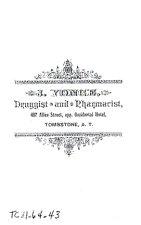
Helene’s younger sister, Merritt, was living with the Yonges at Bartlett Springs at the 1880 census.[31] In August 1880 Merritt married Davis Robert Poland[32], [33], a successful miner from Arizona. James must have heard many glowing stories of the opportunities in the silver mines along the Arizona-Mexico border, for less than a year later he had moved his family from Bartlett Springs to Tombstone, Arizona Territory. They made the trip by train[34], quite possibly the entire distance from Bartlett Springs to Tombstone. They lived in Tombstone during the rip-roaring heyday of the town, and knew all the characters that still make Tombstone notorious.[35] In the 1883 Business Directory James is listed as a partner with T. F. Hudson in a pharmacy on Allen Street, while living on 3rd Street between Safford and Bruce.[36] Later he opened Yonge’s Drug Store and Pharmacy, also on Allen Street and opposite the Occidental Hotel. [37] The design pictured on this page shows the imprinted side of a prescription form found in the collection of the Tombstone Courthouse State Historic Park, Tombstone, Arizona.
James must have had a creative mind and an insatiable curiosity. How many would pass the time on a long ocean voyage learning Morse code? Although he had no academic training in pharmacy or medicine, James learned to be a pharmacist. In correspondence from Althea Yonge to Helen Lind in the early 1950’s Althea makes a reference to a photograph of James in his “laboratory” working over a microscope.[40] And there is a persistent family rumor that he operated “the first” telegraph system in Tombstone, running a line between his pharmacy and “the” doctor’s office. It is true that telegraphy was just coming into the southeast corner of Arizona about the time that the Yonges moved to Tombstone.[41] It is possible that James connected his pharmacy with one of the several doctor’s offices to corner the prescription market. It may even be that he ran the first privately owned telegraph system in Tombstone. But it is doubtful that he introduced telegraphy to the city. Two more children were born to James and Helene during their time in Arizona. Arthur David, who in adulthood called himself Rex, arrived in 1883.[42] Eleanor Cecelia Regina was born in July 1889.[43] Their births bracket the minimum period during which the Yonges lived in the territory. A family letter from England to New Zealand confirms the Yonge’s 1881 arrival in Tombstone: I hear from Jemm, poor Francis’ second son occasionally. He sends me “The Tombstone Epitaph”, a paper published in that dry, metalliferous and rowdy territory of Arizona.[44] …I have had a good deal of bother in getting money for Jemm, Francis’ son now in Tombstone, Arizona. He was in danger of losing his house if he could not stump up. So he wrote to me to get what I could for his resumminary interest in what would come to him at Mary’s death. The family’s departure from Arizona is bracketed by an entry in the Arizona Great Register of 1890 and the 1893 Chicago Exposition. James was registered to vote in Arizona in 1890[45]. We believe the family did not leave before early summer, for the two older children, Madge and Duke, are readily identifiable in a photograph, Schoolchildren of Tombstone, Class of 1890 in the collection of the Tombstone Courthouse Museum State Historic Park[46]. They may well have remained in Arizona through the election season in November. In any case, by 1893 the family had been back in California long enough that Helene had five separate pieces of handwork included in the California display at the 1893 “Chicago World’s Fair”.[47] Once back in California, James and his younger brother, Stephen, purchased a prune ranch in the Santa Cruz Mountains. It is described as “between Alma and Holy City”, and is now beneath the waters of Lexington Reservoir near the city of Los Gatos, Santa Clara County.[48] James apparently had visions of being a gentleman farmer like his cousins at Puslinch, the family seat near Plymouth, England. But to his dismay, raising prunes in California did not offer the same lifestyle as raising apples in Devonshire. By 1895 James and his family were back in San Francisco, although Steven remained in Santa Clara Co. through the 1900 census enumeration[49]. According the 1900 census, James F. M. Yonge and his family were then living at 1032-D Turk Street.[50] In this listing his birthplace is correctly given as Germany, but his age is incorrect.[51] Children John D. (sic), Arthur and Eleanor were living at home. Daughter Madge was enumerated separately. By 1900 she had entered a Roman Catholic Convent of Our Lady of the Sacred Heart across the San Francisco Bay in Oakland.[52] The Yonges were living in San Francisco, probably at the Turk St. address, at the time of The Great Earthquake in April 1906. The younger son, Arthur, was (according to his older siblings) enamored of the automobile and had learned to drive. He was already working as a chauffer, so Arthur was recruited immediately after the earthquake by the Army to be a civilian driver. He was assigned to transport senior Army officials around the city to view the destruction and make command decisions. Helene, too, went out into the community to nurse the injured and ill. James, still a working pharmacist[53], would have been more effective at his post in the pharmacy than working on the streets. The family would suffer from Helene’s decision. She contracted the plague while working in the rubble of the city, and died in 1907.[54] Duke left San Francisco for Hawaii in May 1908 to work as a shoe store manager in Honolulu. Eleanor, still a teenager and seemingly reeling from her mother’s death, defied her father and married a much older man, known as Policeman Davey. After a brief and tempestuous marriage Eleanor fled to her brother in Hawaii, claiming that she feared for her life.[55] Hearing that her husband was following her from California, she fled again, this time to her Uncle Stephen Yonge in British Columbia. By now she was several months pregnant and became horribly seasick on the voyage. Both she and the baby died within days of her arrival in Victoria, British Columbia, Canada.[56] By the time of the 1910 census James had retired and was living with his son Arthur on Jackson Street in San Francisco. Also in the household is Arthur’s wife of three years, Louisa, who was born in Oregon.[57] This is the only record found to date reporting this marriage. James died in November 1910[58], and is buried with Helene at Holy Cross Cemetery, Colma, San Mateo Co., California.
  [1] 1842/159 Eintrage aus den Gerbrutsregistern des Standesamts Koblenz, Rhineland, Germany, Jacob Frederich Yonge, 8.3.1832, Koblenz. Eltern: Johann Franz Yonge, Doctor der Medizin, 31 Jahre alt, aus Plymouth England, und Elisabeth Alice Holmes, wonhaft Kastorpfaffenstrasse 409. Zeugen: Friedrich Mohr, Doctor der Philosophie, 36 Jahre alt, und Heinrich Knauss Instrumentenmacher, 39 Jahre alt. Email message from iyonge@legalisp.net (Pilgrims, Marley Lane, Haslemere, Surrey, GU27 3RF England) to author December 2003 containing both the full German text and an English translation. [2] Helen Y. Lind, Descendants of James Thomas Sr. of Kentucky and Tennessee, unpublished manuscript, 1966. Copy in the personal library of Bonnie Stevens, 20803 Ferretti Road, Groveland CA 95321. Hereinafter cited as Lind manuscript. [3] The author and her husband were able to visit Puslinch in May 1998. Our host was 85-year-old Cyprian Yonge, who took us to meet his brother, Philip, head of the family. We reported to Philip our link to the family and that my great-grandfather had lived at The Crescent. Philip and Cyprian told us about several other family members who lived there, including Old Dr. John who they nicknamed “Dr. A-Pill for-Every-Ill Yonge”. [4] Lind manuscript. [5] Ibid. This family tradition was reported by his son Duke, and frequently repeated by his granddaughter, Helen Lind. [6] Letter, possibly from Charlotte Mary Yonge (Victorian Novelist) to her cousin Anne Yonge and dated August 4, 1863, ref. 308/281. Extract provided by Yonge Family Historian R. Ian Yonge in 2003: Dr. Francis Yonge, referenced as the brother of Delia Oldfield, is the father of James F. M. Yonge. “How strangely sorrows have thickened on the family. Poor Delia Oldfield, … she seems so especially desolate in her helplessness. I am glad Francis Yonge (Dr. John Francis Yonge, (1814-1876), Delia’s brother, whose first wife may have died at this point, and who I suspect of having become a Roman Catholic, which is likely to have destroyed his practice in Plymouth.) was with her, he must be more able to comfort her than any one else, and now that he has no call to other duties or any other home, he can best be with her. …” [7] Yonge family records provided by Family Historian R. Ian Yonge, Haslemere, Surry, England. Hereinafter cited as Yonge Family Records. [8] Plymouth: churches and Other Places to Worship online at http://www.plymouthdata.info/CH-RC-Catedral.htm. downloaded 23 November 2003. Hereinafter cited as Roman Catholic Diocese of Plymouth. [9] Lind manuscript. [10] Another family tradition repeated by his children and grandchildren. The tradition is supported by a letter written by Francis Yonge (father of James F. M. Yonge) in July 1856 telling his brother Fred in New Zealand of the death of their mother. He notes that his boys “will return from France next month”. This letter is now in the hands of R. Ian Yonge, Yonge Family Historian, (Pilgrims, Marley Lane, Haslemere, Surrey, England) with a photocopy in the personal files of Bonnie Stevens. [11] Lind manuscript [12] Yonge family records show that Alice Elizabeth (Holmes) Yonge died 8 February 1863 in Plymouth, Devonshire, England. [13] Yonge Family Records, brief biography provided by R. Ian Yonge. [14] Alaa K Ashmawy, Modern Wonders: The Suez Canal, c. 1995, 1999, 2004 and published online at http://ce.eng.usf.edu/pharos/wonders/Modern/suezcanal.html, downloaded 14 Sep 2001. Work on the canal was started in 1859 and completed about 1867. [15] Lind manuscript [16] Elizabeth (Roberts) Yonge had remarried. Her second husband, the Rev. William Scott had been appointed the first Government Astronomer for New South Wales, so she and two of her sons moved with him to Australia. Here the boys, Kenneth and Walter, went into the wool business. One brother operated a sheep station; the other factored the wool from Sydney. Data from Yonge Family Records and the Lind manuscript. [17] Lind manuscript. [18] Ibid. [19] San Francisco Morning Call, Front Page, Thursday, October 22, 1868, Online at http://www.sfmuseum.org/hist1/1868eq.html, printout date 10 November 1998. “Yesterday morning San Francisco was visited by the most severe earthquake the city ever experienced. The great shock commenced at 7:53 A.M. and continued nearly one minute, being the longest ever known in this region. The oscillations were from east to west, and were very violent. ….” [20] In the 1900 U.S. Census, James gives his arrival date in the U.S. as 1868. See James F. M. Younge (sic), 1900 U.S. Census, City and County of San Francisco, California, 33rd Assembly District, Enumeration District 86, Supervisor’s District 1, Sheet 14A, Page 236, line 21, 820 Railroad Avenue (between 8th Avenue and 11th Avenue), National Archives micropublication T623, roll 102, page 236. [21] If James left England in 1863 and remained in Australia about 5 years, he would have left Australia in 1868. [22] San Francisco City Directory for the year commencing December 1869 and including a General Directory of Residents (San Francisco CA: Henry G. Langley, 1870). James is listed as “J. Yonge, clerk with Joseph H. Drosel, dwg NW corner of Dupont and Geary, #23 Geary.” DuPont runs north and south between Market Street and the San Francisco Bay between Stockton and Kearney in the area now [2004] known as the financial District. [23] James F. M. Yonge household, 1870 US Census, City and Co. of San Francisco, California, population schedule, 1st Precinct, 8th Ward, 408 Montgomery Street Post Office, page 386B (page 14), 23 Geary Street, Dwelling 103, Family 116, National Archives micropublication M593, Roll 82. [24] Lind manuscript [25] Janice T Driesbach, Direct from Nature: The Oil Sketches of Thomas Hill (Yosemite National Park CA: Yosemite Association, 1972) for Thomas Hill’s summer sketching trip. Since there was no wagon road into Yosemite until 1875, James could not “have driven the chuck wagon”, as his granddaughter described. When confronted with this anomaly, Helen Lind replied, “Well, my father really said he cooked and took care of the animals. But it must have been a true story because Nellie Emerine told it, too.” Nellie had once been married to Stephen, a nephew of James F. M. Yonge. Helen Lind corresponded with her in the 1950’s and 60’s. Her independent re-telling of the story implies that the Yosemite trip was remembered as a major adventure in James’ life – more for the time spent in the California wilderness than for his travels with a famous American painter. [26] Lake County, California Marriage Registration, County Recorder’s Office, Lakeport, California, James F. M. Yonge and Hellena Brittain, 3 April 1872. Copy in the personal files of Bonnie Stevens, 20803 Ferretti Road, Groveland California 95321. [27] Lind manuscript [28] James F. M. and Helene (Brittain) Yonge wedding portrait taken in San Francisco, California April 1875. Original in the personal collection of Helen Yonge Lind (934 Kealaolu Avenue, Honolulu, Hawaii 96815). Photographic copy held by the author. [29] James F. M. Yonge household, 1880 U. S. Census, Lake County, California, population schedule, Gravelly Valley, Town of Bartlett Springs, Enumeration District [ED] 32, Supervisor’s District [SD] 2, Page 20, Dwelling 2, Family 2; National Archives publication M593, Roll 82. Hereinafter cited as James F. M. Yonge, 1880 U.S. Census. [30] Barbara Baldwin Salyer, Arizona 1890 Great Register (Mesa, Arizona: Arizona Genealogical Advisory Board, 2001). James F. M. Young (sic) age 48 born England, residence Tombstone. Naturalized 6 October 1876 San Francisco California District Court. Cochise Co., p. 35, Registered 30 June 1890. Herein after cited as Arizona Great Register 1890. [31].James F. M. Yonge, 1880 U.S. Census. [32] Britton (sic), M. and D. R. Poland, announcement of marriage on 7 August 1880 published in the Lake Count Bee, 12 August 1880. Microfilm copy of newspaper at the Lake County Library, 1425 North High Street, Lakeport, California 95453. [33] Poland, now an Arizona ghost town, was named for Merritt’s husband. See http://www.ghosttowns.com/states/az/poland.htm for a description of the area in the last decade of the 20th century. [34] Lind Manuscript. [35] Ibid. [36] Ron W. Fischer, The Tombstone Business Directory, 1883 (1883; reprint, Tombstone, Arizona: Ron W. Fischer Enterprises, 2002), p. 116 [37] Prescription form courtesy of the Tombstone Courthouse State Historic Park, Tombstone, Arizona [38] The author’s favorite is an American folk song, “Down by the canebrake close by the mill, there lived a little girl and her name was ‘Mansadil. ….” [39] Lind manuscript. [40] Althea Yonge of Puslinch, Newton Ferrers, Devon, England (ancestral home of the Yonge family) to Helen Y. Lind (934 Kealaolu Avenue, Honolulu, TH) circa 1953, now held by the author. Unfortunately, a copy of that photograph has not found its way to James’ descendants. [41] Tombstone historical sketch, online at <http://www.desertusa.com/Citites/az/tomb.html>. “By 1881 Tombstone's population was between 6,000 and 7,000 people. In January, the first telegraph was connected to all points of the Tombstone region and the same month, Cochise County, where Tombstone resides, was created making Tombstone an officially incorporated city. Virgil Earp, the brother of former Marshal Wyatt Earp, became the Chief of Police on July 4, 1881 and on October 26, 1881 the Gunfight at the OK Corral took place, killing Tom McLowery, Frank McLowery and Billy Clanton.” [42] Baptismal Registration, Arthur Duke Yonge, Archives of the Roman Catholic Diocese of Tucson, Arizona. Photocopy in the personal files of the author. [43] The Tombstone Epitaph, morning edition, 7 July 1889, page 3, microfilm copy in the collection of the Tombstone Courthouse Historic State Park, Tombstone, Arizona. [44] Letters from Arthur Yonge of Springfield Villa, Clive Vale, Hastings, England to his brother Frederick Yonge in New Zealand (street address not known). The first letter is dated 20 Sep 1881, and the second 11 Nov 1882. Both men are brothers of Francis Duke Yonge, father of James Frederick Moore Yonge. Mary, referenced in the second letter, is James’ stepmother. Originals are held (2004) by R. Ian Yonge, Yonge Family Historian, Pilgrims, Marley Lane, Haslemere, Surry, England. Photocopies are in the personal collection of the author. [45] Arizona Great Register 1890. [46] Bill Roman, compiler, Tombstone Arizona Territory 1880 Photographs (Tombstone, Arizona: Privately Printed, 1998), unpaged, also contains a copy of this photograph. This paperback publication is given away to guests in many Tombstone hotels and motels. [47] California World’s Fair Commission, Final Report: Including a Description of all Exhibits from the State of California Collected and Maintained under Legislative Enactments, at the World’s Columbian Exposition, Chicago, 1893 (Sacramento, California: State Office, A. J. Johnston, Supt. State Printing) 1894 pp. 173, 200. The painting, “Lilies on Wood”, which was part of this submission is held by the author. Herein after cited as California Exhibits at the 1893 Columbian Exposition. [48] California Exhibits at the 1893 Columbian Exposition. In all cases, Helene’s residence is listed as “Alma” and her exhibits are from Santa Clara County. Land records, tax records and directories should be consulted to confirm the location of the land and the period of ownership. [49] Lind manuscript. [50] James F. M. Yonge household, 1900 U.S. Census, City and County of San Francisco, California, population schedule, Assembly District 3, Enumeration District 171, Supervisor’s District 1, Sheet 3A, page 199, 1122-C Turk, Dwelling 27, Household 39. National Archives Micropublication T621, roll 104, page 199. This entry enumerates the entire family. [51] It appears that James consistently reported his own birthplace as England, quite possibly to avoid the necessity of explaining why an Englishman was born in Germany. This is the only census where his birthplace is correctly reported. Was it his wife who talked to the census taker? [52] Madeleine Yonge, 1900 U. S. census, Alameda County, California, City of Oakland, Ward 5, Enumeration District 368, Supervisor’s District 1, Sheet 3B, Convent of Our Lady of the Sacred Heart, Webster Street, line 70. National Archives micropublication T623, roll 82, p. 127. [53] James F. M. Younge (sic), 1900 U.S. Census, City and County of San Francisco, California, 33rd Assembly District, Enumeration District 86, Supervisor’s District 1, Sheet 14A, Page 236, line 21, 820 Railroad Avenue (between 8th Avenue and 11th Avenue), National Archives micropublication T623, roll 102, page 236. This entry enumerates only James. Other sources suggest that this is location of his pharmacy. [54] Helene F. Yonge, death certificate number 136 392, Local Registration Number 5037 (1907) California State Board of Health, Bureau of Vital Statistics, Sacramento, California. [55] Lind manuscript. Several newspaper articles in the “San Francisco Call” 1908-1909 report that James Yonge accused Policeman Davey of attempted murder, claiming that Davey tried to poison his young wife, Eleanor (Yonge) Davey. [56] Ellen Davey death registration, No. 1909-09-022043 (1909)/ Roll b13081, British Columbia Archives Index, Vancouver, British Columbia, online http://search.bcarchives.gov.bc.ca, downloaded 10 Sep 2001. [57] Arthur Yonge Household, 1910 U.S. Census, City and County of San Francisco, California, population schedule, part of the 42nd Assembly District, Enumeration District [ED] 289, Page 4B, 1468 Jackson Street, Dwelling No. 80, Family No. 85. National Archives Micropublication T624, roll 101, page 80. [58] James Yonge, death certificate Local Registered No. 5879, State Index No. 326 20[8?], 1910, California State Board of Health, Bureau of Vital Statistics, Sacramento, California. |

 The Yonges eventually returned to Lake Co. where they are enumerated in the 1880 census at Bartlett Springs, a remote health resort in the hills between Lakeport and the Sacramento Valley.


 The stories told by Madge and Duke of their Tombstone years reflect a busy and happy family. Music was a frequent family entertainment. The children learned to sing all roles in the popular Gilbert & Sullivan operettas, with “H.M.S. Pinafore” being a favorite. Helene contributed songs from her American Appalachian heritage. Some of those have been passed down to the third and fourth generations of Yonge descendants in America.