|
|
May 27, 2006 - Saturday
Thanks to the Advertiser's Jim Dooley for his story yesterday detailing alleged organized crime ties of the former security chief at Aloha Stadium, Herbert Naone.
As I mentioned here last month, Naone is the second man with close ties to Larry Mehau and a top security job to be charged in a similar case.
If I were looking at this happening in any other arena, I would speculate that these investigations were somehow related, perhaps by tips from others unnamed. Perhaps there was some sort of power struggle underway among within the circles they operated in. Dooley is one of the few reporters who might be able to get behind the front story and dig deeper into the "politics" of this fascinating drama. I'm looking forward to his further reporting.
Earlier this month, In These Times took a look at Hawaii's practice of shipping inmates to mainland prisons, what it calls the "lowest-bidder-gets-the-convict shuffle game".
Joel Kennedy, who spent a lot of years in communications in the corporate world (and some outside of it) before "retiring" to Hawi on the Big Island offered up a few thoughts about legislative interns:
Serving as a legislative intern can be a great learning experience for anyone -- student, labor union member, non-profit staffer, or business exec. (Businesses are not the only entities that provide legislative interns.)
When I was vice president - public affairs at GTE Hawaiian Tel, we sent one management employee per year to serve as a legislative intern. We picked younger managers on the premise that the experience would help make them better senior managers as their careers progressed. It was never easy to give up a key employee for four months, and often the interns had to balance their duties at the capitol with the ongoing need for their expertise back at the company.
So, why do it? Business people can be better leaders with first-hand knowledge of how government operates. In my experience, some of the worst complainers about legislative decisions are those who have never darkened the doors of the capitol or talked face-to-face with a legislator. And it's good for legislators to have exposure to business interns as well. Everyone learns from the experience.
If an intern program is worth having, however, it should be a formalized, open program. The interns we sent from Hawaiian Tel were part of a Chamber of Commerce program that included interns from a number of companies, and the Chamber always publicized the program so its existence was never a secret. Anyone who wanted to know who the interns were and which offices they were working in could find out very easily.
I don't know why the Chamber stopped its program. Having an open, well-publicized program would probably end the speculation about nefarious doings by interns. Individual intern assignments that are arranged between individual legislators and any outside entity (not just businesses) probably deserve to be questioned.
Thanks for that perspective, Joel.
Meanwhile, I have to report the bad news that despite our best intentions, the black cat died during surgery yesterday. I got the call about 12:15. His heart just stopped as they were about finished working on him. He was too wild to be examined before the surgery, although he appeared bright eyed and generally healthy. He was scared, though, and the stress likely played a role. In any case, I felt very bad for the rest of the day, as if we lured him in for medical care with promises of a better life, and instead his life was ended. All I can say is that we did the best we could for him, certainly more than most people would have done.
So it goes on this Saturday.
May 26, 2006 - Friday
We took the poor frightened black cat to the vet yesterday morning. With any luck, he'll be successfully snipped this morning and ready to bring home and release this afternoon. We did, though, request a feline leukemia test. This disease has not been a problem out here in the past, but we decided that we needed to test in order to protect the rest of our cats.
| The power was out in Kaaawa when we got back from the vet around noon, and I got a call a few minutes later to check out the scene down at the end of Hauhele Road. A National Guard truck had accidentally snagged the overhead wires and then pulled down a pole while trying to back up. |
 click for larger photo
|
The pole fell over onto the home of retired postmaster Jarrett Pang, who was home at the time. Jarrett was smiling when he emerged, although it was unclear how much damage the house sustained. Power was restored by mid-afternoon, but the road was blocked off and crews were working all afternoon.
Now that a complaint has been filed with the Ethics Commission alleging the director of the HMSA Foundation violated the law by failing to register as a lobbyist, it's worth looking at the definition of a "lobbyist" (Chapter 97 HRS).
(6) "Lobbyist" means any individual who for pay or other consideration engages in lobbying in excess of five hours in any month of any reporting period described in section 97-3 or spends more than $750 lobbying during any reporting period described in section 97-3.
(7) "Lobbying" means communicating directly or through an agent, or soliciting others to communicate, with any official in the legislative or executive branch, for the purpose of attempting to influence legislative or administrative action or a ballot issue.
Generally, enforcement of this provision is passive, meaning that the commission doesn't appear to seek out and assess the activities of unregistered individuals or groups that appear to be targeting official policies. This has, in my view, led to chronic under reporting of lobbying activities.
On the other hand, the definition provides quite a lot of wiggle room, allowing quite a bit of legislative or administrative involvement without necessarily crossing the legal threshold requiring registration as a lobbyist.
For example, in the past, it was understood that certain tax exempt groups prohibited from lobbying could present information at legislative hearings if called upon by legislators to answer questions. Can a group be accused of lobbying if it merely responds to legislative requests that relate to its area of expertise?
Does communicating with legislative staff qualify as lobbying, since the law limits this to communicating with "any official" and not "any employee"? An official is generally a government employee with decision-making authority, which would exclude most legislative staffers.
All this just to suggest that the legal boundaries of lobbying are soft and permeable.
| And here's a photo for feline Friday, a shot of Mr. Toby posing on a large rock in front of our neighbor's house yesterday afternoon. The lighting was just right for a black and white treatment. |
|
May 25, 2006 - Thursday
| There was much anxiety early this morning as I prepared to trap the black cat. I started just before 5 a.m., but it took me a bit to figure out the logistics of the trap. Then there was high anxiety as Mr. Cat wandered around but refused to be enticed by that smelly tuna cat food. But by 5:45 he was no longer a free man. And soon, with any luck, he won't be a complete cat either. We've got the Humane Society certificate and he's heading for the vet shortly. |

black cat waits
|
Cat is a little uncomfortable in the somewhat small trap but otherwise seems fine. I, on the other hand, am a nervous wreck and, as a result, I think I'll just cut today's entry rather short.
Ann Wright, Honolulu resident and former diplomat who has emerged as a leading critic of the war in Iraq, was arrested this week distributing leaflets about an anti-war documentary on a military base in Washington state. Here's an interview with her by Democracy Now.
| On a December day back in 1969, just months after coming back to Hawaii to enter graduate school at UH, Meda and I drove up to the top of Halekoa Drive to look at the houses then being built up high on the ridge. I suppose that I should try to find the same homes today and get another round of photos. Maybe over the weekend. Just click on the photo for the full series. |
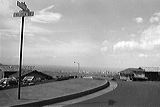
Halekoa and Alaeloa
Waialae Nui Ridge, Dec. 1969
|
May 24, 2006 - Wednesday
I finally got my copy of the current Pacific Business News yesterday (it wasn't delivered on Friday and then I didn't get to the post office until yesteday morning). It also features a good story on the rental housing market, but with findings that contradict Sunday's story in the Advertiser. [Early readers found the wrong link, but it's been fixed now.]
PBN's Nina Wu, for example, says it is still a "landlords' market" with few owners reducing rents or offering freebies to attract renters. Median apartment rents, according to data quoted in the story, are higher than a year ago.
Then last night we were tuned to the 6 p.m. news on KGMB and I was a bit shocked by an over-hyped story that used blatant fear mongering to drum up concern over internet privacy. The story ran under the headline, "We know where you live." As if where you live is always deeply personal bit of information.
"(You can find) very, very private information," said Freeman. "It's, unfortunately, already out there."
I see several big problems with this story beyond the general sowing of fear to push ratings.
First, although the reporter's comments kept referring to the extremely private nature of the information that was found by Google, for example, it all seemed to be from published accounts, old news stories, etc. In some cases these were stories that the individuals had previously told for publication. They weren't secrets learned by someone listening at the bedroom door. Scary? No. Interesting? Sure.
Telephone numbers and addresses? Phone books still turn up most of these. Other addresses are from real property records showing property owned, not necessarily a residence.
But the worst thing about this approach is the lack of explanation about what journalists should know best through first hand experience--the public benefits of an open society and access to precisely this kind of information. We're just two months past the annual "Freedom of Information" observations, when journalists share concern over access to public records. But here KGMB fans public hysteria and invites a move to close off large segments of public records.
On top of this, promos for the late news were iimplying an upcoming pitch for a company promising to "fix" the privacy problem the early report had tried to create in viewers minds.
KGMB should be debunking the myth of "privacy" where appropriate, showing people that this is really simple stuff that isn't typically private and that they probably routinely share with others. And KGMB should be explaining why and how keeping government records public, including things like real estate records and court documents (yes, including divorce records), contributes daily to the freedoms we so casually enjoy.
Secrecy and dictatorship go hand in hand.
Okay, that's a cheap shot, but it's true that stories like the one broadcast by KGMB yesterday do dissservice.
It started raining just after 4:30 a.m., a light, steady rain that falls with a soothing patter, accented by the occasional burble of an overhead gutter or drip from a low hanging branch. It's a nice way to rev up the senses. It was preceeded by a loud screeching on the front deck as I was filling cat bowls in the kitchen, probably the result of black cat meeting Silverman as he came up the stairs. Within 20 minutes the rain has turned to a light drizzle and it's getting hard to hear the difference between the sound of the rain and the wind in the trees. Ten minutes later, the rain is gone, leaving only the wind and the cats. This admission comes from a friend at the Star-Bulletin:
That "particular person" at the Star-Bulletin who sometimes was barefoots was likely me. It helps my old achin' back to sit crosslegged while typing, and no can do while wearing shoes, so I'd wear slippahs to work and slip them off while working at my desk. I suppose I can take pain meds now that I can't sit properly, but those are the breaks. There are always office busybodies, no matter where you work, who can't resist whining about everything other coworkers say and do and think. That said, our "dress code" is still pretty casual, and it certainly doesn't hurt to look more professional. When I started in newspapers, we had to wear white shirts and dark ties. I don't miss those days.
So is that the end of slippergate?
Seeing the Republicans complaining to the Ethics Commission about Rep. Jerry Chang's failure to make a timely disclosure of his personal involvement in a business that would have benefited from a $50 million tax break sought for an Oahu race track during this year's legislative session, I can't help thinking that the Democratic majority should be proactive in these cases rather than allowing the opposition party to make political points off of these obvious problem cases.
Chang's misstep angered fellow Democrats, but they should have an automatic procedure in such circumstances to seek an ethics review. Failure to do this begins to make "ethics" seem like a partisan issue which then forces unhappy Democrats onto the defensive on ethics issues, even if they are outraged by the original conduct. With the Ethics Commission offering a simple venue for sorting out issues, legislators should be taking advantage of its services whenever these cases arise involving members of either party.
| One afternoon in December 1970 I had camera in hand when we walked from our apartment on 9th Avenue up to the Kaimuku Community Park, on Waialae between 10th and 11th. I found these images among my negatives. Kaimuki has changed in 35+ years, but not a lot. |
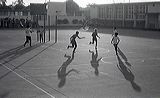 Kaimuki 1970
click for more
|
May 22, 2006 - Monday
The Advertiser has an excellent story by Dan Nakaso this morning on the shift in Hawaii's housing rental market, reflecting the slowdown in the overal real estate market. Nakaso describes the chain reaction as prices stall or decline:
Landlords and property managers say the increased supply is being fueled, in part, by military families moving back to the Mainland while their military members are deployed to Iraq or Afghanistan; and by real estate investors who can't resell their properties at the prices they want and have to add them to the pool of rental properties already on the market.
The addition of even more rental homes means that some landlords — already facing rising property appraisals and property taxes — have to cut rents just to keep properties occupied and cash flowing through their units.
It's a very interesting assessment of a quick about-face in the market.
A reader responded to the comments here last week about the Star-Bulletin's new "no slippers" policy.
Just wanted to comment on the hoopla about the SB not allowing slippers to be worn in the newsroom any longer. I know folks there and they provide a different view then the one you described.
The change evidently came down due to one particular person always walking around barefoot. Barefeet and slippers work real well at the beach but in a professional office environment it's not so cool.
I thought the slap at the SB editor for "putting his foot down" (with shoes of course) on this practice was uncalled for. I doubt very seriously they allow bare feet and slippers at the Advertiser or any other daily paper in Hawaii. You can be "local" and still have proper footwear while at work.
Anyway, I guess there's slow blog days just like there's slow news days...enough already.
And retired Star-Bulletin editor Chuck Frankel forwarded this book recommendation:
I recommend "Overthrow: America's Century of Regime Change from Hawaii to Iraq," a new book by Stephen Kinzer, a former New York Times correspondent in Turkey, Germany and Nicaragua.
While the story of US interference and intervention in Cuba, the Philippines, Guatamala, Chile, Iraq, Iran, Afghanistan and other countries is not new, the linkage to Hawaii is startling.
|
|
Hawaii's Queen Liliuokalani was overthrown because business interests wanted it, and they were aided and abetted by the White House, American diplomats and American troops. This pattern was repeated over the years. Kinzer writes that no nation has arranged to depose of so many foreign leaders in so many places so far from its own shores than the United States in modern history.
Alas, Hawaii showed the way it could be done.
| So while Chuck's reading enlightening fare, what do I have to show for a relatively free Sunday afternoon? How about a few more images of cats? That's Mr. Silverman perched in the window of his favorite room while Leo lurks just outside. In any case, click on the photo for a few more Sunday cats. |
|
It was another "two newspaper town" morning yesterday, with competing headlines:
Honolulu Advertiser: "Flaws found at Kauai dams"
Honolulu Star-Bulletin: "Flaws seen at Kauai dams"
So much for diversity.
It was also a day without power, with electricity out in Kaaawa from about 9 a.m. until shortly after noon. Other windward areas may have been out longer. At 1:49 p.m., the Advertiser posted a "breaking news" update attributing the problems to "power lines that shorted out when the[y] became tangled in trees in the Malaekahana near Ka'a'awa."
Perhaps they meant it was a problem in Kahana, which is near Kaaawa, since Malaekahana is as far from Kaaawa as Kaneohe. Unknown whether the confusion originated with HECO or the reporting.
| This is more than a blurry photo. Click on it and you'll see a slightly more legible version of the discounted Honolulu Advertiser subscriptions packed in plastic cases and stacked for sale in Costco. It proclaims a 40% saving, with a 20-week sub (if I read the blur correctly) for $47, which the package compares to a regular price of $81. |

Gannett at Costco
|
The Advertiser's web site, on the other hand, offers new subscriptions for $2.67 per week for 12 weeks, which would come to $53.40 if it were available for the same 20-week term.
It's the first time I've seen this kind of newspaper as commodity. I wonder if this is a nationwide Gannett deal, with different papers in each market?
| And, finally, I've managed to catch up with my favorite Kaaawa photos taken during April. These come right on the heels of the long-delayed March gallery, but that's what finally catching up is all about. |

Kaaawa Gallery
April 2006
|
|
|




