|
|
Recent photos: Vieques (Puerto Rico) 1978 • Malaekahana 1959 •
Historic Kualoa sugar mill • Kaaawa in November •
March 10, 2007 - Saturday [ permalink ]
Russell Pang, the governor's chief of media relations, responded yesterday to the report of Lingle's condo sale & quick profit:
I want to set the record straight regarding your March 8 blog post about Governor Lingle’s financial disclosure reports, specifically relating to a transaction of a condominium in Hawai‘i Kai.
Here are the facts regarding the Governor’s full disclosure of this property.
• April 13, 2005, Hawai‘i State Ethics Commission Disclosure of Financial Interest Report – property in Peninsula Hawai‘i Kai listed as “addition in interest.”
• April 7, 2006, Hawai‘i State Ethics Commission Disclosure of Financial Interest Report – the property is listed as “interest in real property held.”
• Note: The property was sold on April 28, 2006
• August 15, 2006, Hawai‘i State Ethics Commission Candidates Disclosure of Financial Interest Report – property was listed as “Transferred” (sold) with a value of “I” ($500,000-$750,000).
• February 1, 2007, Hawai‘i State Ethics Commission Disclosure of Financial Interest Report – Governor checked, “I have no changes to report since my last filing.”
The fact is, you ignored the August 15, 2006 report which fully disclosed the sale of the property.
All of these documents were properly filed and are on record with the Hawai‘i State Ethics Commission.
And I replied:
Thanks for your clarification.
I will report it tomorrow.
My own reading of disclosure requirement is straight forward.
The required candidate's statement appears distinct from and difference in substance from the annual report required of elected officials and others.
For example, the annual report includes the relevant information for spouses and dependent children, whereas the candidate disclosure covers only the candidate personally.
The disclosure period for the governor's annual filing is for the calendar year "from January 1 of the preceding calendar year to the time of the filing of the employee's or legislator's disclosure of financial interests. " Section 84-17 HRS.
I don't believe that the filing of a candidate disclosure is a substitute for the subsequent filing of the regular annual report covering the full calendar year in which the election is held. In fact, this is written into the statute in the same section, which requires filing of an annual report, going back over the previous calendar year, within 30 days of one's election or appointment. Clearly, this indicates that the candidate report is not a substitute for the full filing going back to January 1 of the prior year.
Admittedly, the overlapping candidate and annual disclosure requirements are perhaps confusing, but the disclosure period for the regular annual report seems very clearly stated in statute.
In any case, thanks for your reply.
An Associated Press story on the matter by Mark Niesse appears in today's Star-Bulletin. It adds that Lingle turned around and reinvested her profit in another more expensive condo. This transaction does not appear in the financial disclosure filed this year and wasn't mentioned in Pang's reply, although like the sale it was perhaps reported in her candidate disclosure.
Dan Mollway, executive director of the State Ethics Commission, is also quoted:
"I don't think she can be said to have violated the state ethics laws, because she was doing what she thought was appropriate and complying with the law," Mollway said. "Given the lack of clarity between the candidates' disclosures and the annual disclosures, that's quite understandable."
Read another way, Mollway confirms that Lingle didn't comply with the disclosure requirement but said the confusion between the candidate disclosure and annual disclosure is "understandable".
I would say that it's understandable for a first time candidate but Lingle is a political veteran who has been through the drill many times before and should have known better. This should also prompt the Ethics Commission to quickly advise elected officials that their annual disclosures are just that, annual, and should cover the full prior year.
March 9, 2007 - Friday [ permalink ]
USA Today published a story earlier this week describing "racial tensions" in Hawaii. The story describes the recent "road rage" incident on Aha and an incident in January on the Big Island where haole campers were beaten by a group of local men. This latter case earned just a brief mention in the Star-Bulletin a month after it occurred, although it was reported by West Hawaii Today on January 31.
The underlying theme of the USA Today story is that such incidents are deliberately under reported.
Racial troubles in the islands usually don't get much public discussion. In a tourism-dependent state, talk about tensions is "like news about shark attacks," says Jon Van Dyke, a University of Hawaii law professor. "People are afraid they might lose customers."
A serious charge, but I'd be hard pressed to say that it's not true.
Several people commented on Gov. Lingle's success in the real estate market, although I didn't see any mainstream folo this morning. Here's one reader's reaction:
waitaminute. While publicly turning up her nose at real estate flipping, lingle bought and sold a condo within 15 months for a $180,000 gain? That's priceless. Why hasn't the media here jumped on this yet? Considering that some legislators want to punish flippers by creating a new state law, the whole issue is crying out for an enterprise piece on state officials who have flipped real estate for profit. or does this not fit the criteria of "relevant, compelling and interesting" for the local press?
Have I mentioned my camera? It's a Canon 350D, a digital SLR not quite two years old, and last weekend it suddenly stopped working and signalled "ERR99". Turns out error 99 is a general error message that could indicate a wide variety of problems. But after trying to replicate the error various ways, I believe the problem is really with my favorite everyday lens, a Canon 17-85mm zoom. Now I've got to find the time to deliver camera and lens to Canon to the lens fixed and the combo checked. I'm not a happy camper.
| Feline Friday this week features Kili and Wally, the two sisters we rescued back at the beginning of 1998. We were surprised to realize that they're now nine years old and the senior cats in our current household. Click on the photo for a larger version. |
 Kili & Wally
|
March 8, 2007 - Thursday [ permalink ]
Oops. Governor Lingle checked off the box indicating "I have no changes to report since my last filing" when filing her financial disclosure form for 2006 with the State Ethics Commission in early February of this year.
Apparently the $178,864 gain from the sale of her two bedroom condominium in the Peninsula Hawaii Kai last year slipped her mind. It could happen. After all, she only owned the apartment for 15 months.
Lingle's financial disclosure covering calendar year 2005 reported purchase of the 1,287 square foot apartment on January 29, 2005 for $416,136. Although the sale is not disclosed on the governor's most recent financial disclosure, property records show it was sold just 15 months later, on April 28, 2006, for $595,000.
That's a relatively quick profit of $178,864 or 42.3 percent.
Seriously, though, I should say that a quick look at comparables didn't indicate obvious funny business with the transaction. Both the reported purchase price and sales price appear in line with other transactions in the project. So I'm assuming this slip of the pen was a simple oversight that will be solved by a quick amendment to the Ethics Commission form.
A reader responded to yesterday's post about health benefits and the floor debate over a floor amendment that referred to earlier legislation requiring private employers to offer health coverage to domestic partners. Although referred during the House debate as the reason to now offer "parity" to public employees, it seems that earlier statute didn't really accomplish what it seemed to promise.
Both your post and Treena Shapiro's article in the Advertiser indicate that private employers are required to provide benefits for reciprocal beneficiaries. That isn't the case. While the statute appears to do so, it's preempted by ERISA (or at least a strong argument can be made) and was basically interpreted out of existence by the AG's office not long after it was passed.
The relevant statute is found in Section 431-10A-601HRS.
Any other law to the contrary notwithstanding, reciprocal beneficiary family coverage, as defined in subsection (b), shall be made available to reciprocal beneficiaries, as defined in chapter 572C, but only to the extent that family coverage, as defined in section 431:10A-103, is currently available to individuals who are not reciprocal beneficiaries.
There were actually two attorney general opinions that gutted what was presumed to be the intent of the law. The first was #97-5, issued in August 1997, which concluded the statute applies to insurance companies rather than employers because of its placement in the insurance code, and further that it does not apply to the so-called "mutual benefit societies" that provide most of Hawaii's health coverage (HMSA, etc).
Opinion 97-5 noted:
We are aware that this interpretation will result in a relatively small number of individuals having access to reciprocal beneficiary family coverage. The total number of subscribers of health care coverage who obtain coverage through their employers is approximately 320,000, of which only about 1,800 have coverage through an insurance company.
This was followed by Opinion #97-10 in December 1997, which held that employees, and not employers, are responsible for additional costs of reciprocal health benefits, if any.
Let's hope that, if this latest bill eventually passes, that it will be more successful at actually delivering the goods than the reciprocal benefits statute passed a decade ago.
March 7, 2007 - Wednesday [ permalink ]
There were a few unusual moments in the House yesterday afternoon when an amendment was offered on the floor to add provisions for domestic partner health benefits to a bill concerning the Employer-Union Health Benefits Trust Fund.
If floor amendments are a rare breed in Hawaii, successful floor amendments are really an endangered species. But this one passed. The amendment was offered on the floor following behind-closed-doors political wrangling in the Democratic caucus. The bill, as amended on the floor, will be considered for passage on third reading on Thursday afternoon.
When it got to the floor, it was backed by Rep. Sylvia Luke, one of those who lost out in this year's leadership battle, and ended up passing with with 47 "aye" votes, including that of the Speaker, suggesting it had gathered majority support in caucus. Even Republicans got on board to give public employees the same reciprocal benefits as required by law in private industry.
The bill, HB1290, was originally intended to "eliminate confusion or misinterpretations regarding which 'beneficiaries' of an employee killed in the performance of duty or of a deceased retiree are eligible to become EUTF employee-beneficiaries".
As amended on the floor: "The purpose of this Act is to ensure parity between unmarried couples and married couples by extending the benefits provided under the State's employer-union health benefits trust fund to reciprocal beneficiaries."
A story by Treena Shapiro in this morning's Honolulu Advertiser highlighted this bill but ignored or remained oblivious to the significant politics of the floor amendment process. The Advertiser story also describes the bill as applying to state employees, although it appears to cover all state and county employees who are covered by the Employer-Union Health Benefits Trust Fund.
Although a Star-Bulletin story this morning made only a brief mention of this measure, Richard Borreca and B.J. Reyes did get it right on the inclusion of county workers.
Of course, the language of the floor amendment was not available to the public yesterday afternoon when the debate and vote were taking place, but that's in the nature of this kind of maneuver. However, the floor draft is online this morning. I suppose that's why the 48-hour period is required before the final vote to give the public an opportunity, however limited, to review and react.
After the Advertiser story yesterday about an experimental HPD web site with crime statistics from Oahu's north shore, I ran across this Maui Police Department site, "Unsolved Crimes and Wanted Individuals".
Is there a story about the kitten that appears at the top of the "Wanted Individuals" list? Anybody on Maui have any idea?
Another reader commented on the S-B's redesign:
My first impression from Monday's newly redesigned Star-Bulletin: The front page looks like a cross between subway freebie paper and USA Today.
Is this new look supposed to appeal to home readers at night? Or is the Bulletin trying to get a jump on rail transit sales? Who is the customer?
You can tell they are trying really, really hard to sell the paper, but the amount of energy required to keep up this sky-high level of hype every single day is going to be enormous. Best of luck to them.
And speaking of the Star-Bulletin, this invitation comes from Mark Coleman in the S-B newsroom:
Hi y'all,
Hey, my band the whaley boys will be the first of four bands playing this Friday at Anna Bannana's, so if you're not doing anything, come on down!
We start at 9 p.m.; we'll be done by 10, leaving you plenty of time to do something else afterward, including go home and go to bed or hang around and listen to the other three bands (Linus, Busekrus and the Crud).
The best part: It's free! (though you'll probably want to bring spending money for drinks)
The whaley boys features me on bass and vocals, my brother Kevin on harmonica and vocals, M.J. Fogarty on lead guitar and vocals, Scott Cooley on drums, and Joey Carroll on rhythm guitar and ukulele. It's blues with an edge -- and a little island flavor -- and we're going to have a rockin' 45-minute set, to set the stage for the three alternative rock bands that will be following us.
I hope you can make it down.
March 6, 2007 - Tuesday [ permalink ]
Sorry, folks, that Volcano house has been rented. Here's what Bill Harby had to say about it: " I got a few quick responses and am happy to report that two guys from Newfoundland will be renting the house -- and thus covering the cost of my plane ticket to Malaysia!"
The reader's comment yesterday about the lack of reporters at an important Senate hearing elicited this observation:
I've looked around for press in the hearing room from time to time and been surprised to find none. But these days the audio from hearings is broadcast around the Capitol and if Capitol TV is covering the hearings, the video also. So you never know if the press is covering something by remote control.
Aha. Of course, now we have to ask how much is lost when an event is covered remotely. There's so much that doesn't get on camera. And then there's the question of whether the absence of reporters makes a difference in how hearings are run and how legislators behave, etc.
The Star-Bulletin's new design drew a number of comments and spawned a fledgling thread at HawaiiThreads.com.
But thanks to a helpful source, here's what Star-Bulletin editor Frank Bridgewater had to say in a memo to newsroom staff:
Everyone has a big role to play to make it work. Keep in mind that it is a two-pronged approach. The new format may be the most visible, but the other element is just as important -- what we write about and how we write it. Remember that while we still will have the room for a longer story, we need to think about whether the topic warrants it (particularly factoring in the time lag between when an event happened and when the paper will hit the doorsteps). If it doesn't need a longer story, write it shorter and move on to other stories, especially enterprise. (You may have seen that the Washington Post issued guidelines on story lengths, with the directive: "Every story must earn every inch.")
Headlines will play a prominent role -- there will be more of them and they will have to help make it quicker and easier for the reader to take them all in when looking at a page. Try to stick to the active and descriptive words and avoid the flat, mundane headlinese words such as set, sees, eyes, slates, hikes, inks, probes, etc. And with more heds, it is more important than ever to help the reader by avoiding bad bad breaks in heds, such as splitting verbs and phrases and leaving a preposition hanging at the end of a line.
Finally, remember that the ideal story will be relevant, compelling and interesting -- it should include at least one and hopefully two or three of those attributes.
It's hard to predict how this will play out in terms of journalistic content. The "write it shorter and move on to other stories" is a bit worrisome, but then Frank qualified it with "especially enterprise." That can be good news if it means empowering reporters to go after and develop those enterprise stories without the excessive editorial approvals needed up the street at the Advertiser.
| Larry Geller (DisappearedNews.com), who describes himself as a former "copy editor and then managing editor of our college newspaper in an engineering school", penciled out his own reaction to the new Star-Bulletin. To read Larry's comments, just click for a larger version |
|
And here's a comment from another Toby fan, along with a photo of Toby himself taken yesterday morning:
Orange and White cats are the best !!
Wouldn't it be fun to hold a Toby look-a -like contest ???
I have several entries of managed colony cats I could send in and who knows we might even find JB, formerly of Kaaawa, a new cat !
|
And so it goes. Happy Tuesday.
March 5, 2007 - Monday [ permalink ]
A reader notes that the web site of Ka Leo, the UH Manoa student newspaper, has been missing in action for a couple of weeks. Perhaps someone can let us know what's going on.
Today marks the launch of the Star-Bulletin's new format, which is designed to emulate the structure of a web site. I've just taken a very quick look and will have to defer any judgements. There's a lot more use of color and photos, probably good except that it will pose a real challenge for the MidWeek presses, which have consistently had trouble with color registration.
I also find the use of many different type faces and type sizes side by side unnecessarily distracting. There seems to be little uniformity in headlines, for example, making the page a jumble of competing sizes and shapes. In any case, it will take some getting used to, probably on the production end as well as the readers' end.
In Sunday's Star-Bulletin, a printing mix-up put several A-section pages back to back with pages from the C-section, requiring readers trying to follow stories to search the paper for the misplaced pages.
Another reader had this comment on coverage of the Legislature:
Pretty disappointing that there was no press coverage of the confirmation hearings for two key Gubernatorial judicial appointments before the Senate Judiciary Committee (on Friday). One key appointee, DCCA Director Mark Recktenwald was rated highly qualified by the State Bar Ass’n for Chief Judge of the Intermediate Court of Appeals (deservedly so in my opinion) but there is a bit of controversy involving the Circuit Court appointment but apparently no press there except O’lelo streaming video.
Another fun fact . . . Senator Lorraine Inouye can be seen on the O’lelo streaming video with an O’lelo travel coffee cup in front of her during the hearing. Wonder how many legislators got this perk? I realize it is de minimus but still.
I received that comment on Friday night. It must have been referring to broadcast news coverage of the hearing, as both the Advertiser and Star-Bulletin ran stories the next day. The Advertiser focused on the Recktenwald nomination to the Intermediate Court, while the Star-Bulletin pounced on the questions raised about Circuit Court nominee Glenn Kim.
| Here's a note from Bill Harby in Volcano [Update: The house was quickly rented. Sorry!] "Does any of you know of anyone who might like to rent my lovely little cottage in Volcano on the Big Island for about a month this summer?"
|
|
He goes on:
"I'm flexible on dates but they would be sometime between June 17th and July 28th. The rent would be $900 for a month, or more or less for longer or shorter periods. The renter needs to be very responsible and respectful of other people's property -- and they need to like cats. I have one very charming feline who'll need feeding and some TLC. The house is perfect for a couple or an individual."
If you're interest, email me (ian@ilind.net) and I'll pass along his contact information.
March 4, 2007 - Sunday [ permalink ]
| My sister's husband, Ray Stevens, artist and wood carver, died at home yesterday afternoon in Groveland, California, after a long and painful struggle with lung cancer. Bonnie has been blogging through the experience of the past 15 months. Her blog, Life with Cancer -- Ray Stevens, started in January 2006, and she added perhaps a final entry late last night notifying readers that he's gone. |
|
Aloha, Ray.
Celebrate life. Pet a cat, or nine. Carry a biscuit to your favorite dog. Hug your partner. View the sunrise, or the sunset. Listen to the birds and the ocean. Taste a grape and a glass of wine. Feel the wind. Caress a leaf. Watch a tree grow. Share a laugh. Wonder about the stars. Enjoy the day.
March 3, 2007 - Saturday [ permalink ]
I haven't heard details of the Star-Bulletin's major design makeover, due to make its appearance next week, but I'm looking forward to what their design wizards have come up with.
It's Saturday morning and, after reading a Maui News story about the county council and the so called "Sunshine Law" (thanks to Doug & Poinography.com for the link), I'm about ready to seriously propose that the law needs to be repealed and replaced with something sane. Somewhere along the way of adopting the long series of tinkering amendments to the sunshine law over the past 30 years, we've lost sight of the original intention--to end secret decision making and move as much of the political process as possible into the public arena--and now face a bizarre twist in which "sunshine" is being asserted as a reason for excluding members of the council from participating in public business during public meetings. Instead of fostering openness, the sunshine law is being used as a hammer to restrict public discussion. It is almost too strange for words.
According to the story, the Office of Information Practices has informally opined that council committee meetings must be closed to council members who are not named members of the particular standing committee.
I'm having a hard time fathoming the logic behind this one. The council is organized with a number of five-member committees. The sunshine law applies to these standing committees which are required to hold public meetings, which by law "shall be open to the public and all persons shall be permitted to attend any meeting...."
Read that one again: "...shall be open to the public and all persons shall be permitted to attend any meeting...."
I can't find anything in the general open meeting requirement that would limit a council member' s right to sit in on another committee, especially in light of the overall presumption that council interactions should take place in public meetings.
Remember that overall original intent, written in to the law in a declaration of policy and intent, which reads in part: "Therefore, the legislature declares that it is the policy of this State that the formation and conduct of public policy - the discussions, deliberations, decisions, and action of governmental agencies - shall be conducted as openly as possible."
How in the world does an extra council member's participation in a public meeting contravene that intent?
In my own experience, council members are rarely eager to create more work for themselves by attending meetings of standing committees they have not been named to. On the other hand, it is common for members to sit in on a meeting of another committee considering a matter than impacts their own district or has unusual public interest. Those additional members don't have votes on the committee but have traditionally been accomodated as a courtesy, if nothing else. Their participation is not hidden and these interactions occur in a properly posted public meeting, which is the whole goal of the sunshine law, so that's why it is difficult to fathom why this practice is being frowned on by OIP.
What sense does it make to somehow interpret the sunshine law to allow anyone else in the world to attend and take part in a public meeting while turning away an elected member of the council in the name of some strange sense of openness? That logic is beyond me.
Poinography.com, in yesterday's entry, also noted my Friday ramblings on the Ko Olina tax credit and commented on a statement that the general fund would retain the $75 million if the budgeted tax credits were not used.
Does that sentence mean that for every year the tax credit was available the Lege had to assume during budget calculations that some or all of the credit would be taken and, thus, had to reduce spending by a similar amount?
That's precisely what a budget is all about. Take available revenues and plan on how to expend or save them. If you plan on reducing revenues by $75 million via a multi-year tax credit, then you have that much less to expend on other things. And if you reduce tax revenues by $75 million via a big tax credit without budgeting accordingly, you end up with a big budget shortfall.
In any case, I agree with Doug that responding to each other is the blogger's "easy way out". It is, after all, Saturday.
March 2, 2007 - Friday [ permalink ]
The House and Senate money committees (Finance and Ways & Means) have been going at a mad pace to meet today's decking deadline. All bills that are going to survive have to be "decked" today for consideration on third reading next week. An alert reader caught this on the bottom of a House Finance Committee meeting notice yesterday: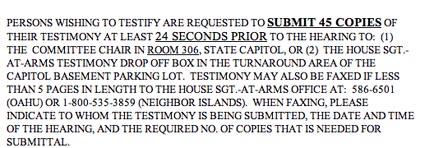
Turning that last minute testimony around in 24-seconds must have been quite a trick!
Doug White, who writes the always interesting Poinography.com, was sailing yesterday so I'll take the opportunity to take issue with one of his entries this week. On Tuesday, he commented on a Star-Bulletin story concerning bills to repeal or retarget the $75 million in tax credits that had been set aside several years ago for the aquarium at Ko Olina.
Doug takes lawmakers to task for talkng about "imaginary money" and being confused when they talk about this tax credit "as if it were an appropriations bill".
Actually, this is a common approach used to prepare a "tax expenditure budget", and has been used to understand and highlight uses of tax funds that otherwise aren't seen by the public because they are doled out as invisible credits rather than appearing in the budget as line items of spending. Federal law, for example, requires preparation of a tax expenditure budget, a listing of those tax expenditures--credits and exemptions--in the annual federal budget.
In the past, businesses or special interests would be given huge tax breaks while other community needs would be met through direct appropriations. But when things got tough financially, the cuts would be made in appropriations and all those tax breaks--in essence, giveaways of what would otherwise have been taxes collected and available for public use--went unseen and unexamined. So speaking of tax credits as expenditures serves a significant public purpose by giving a more complete picture of where money is going.
Then Doug goes on:
“The money” is not the State’s to spend, and until Ko Olina (or another taxpayer) builds the facility there is no $75 million!
Not so, Doug. Using the Ko Olina credit as an example, it's correct to say that the Ko Olina tax credits wouldn't have been taken, or expended, until constructon of the aquarium had been underway. But don't confuse the credit with the taxes it offsets. The taxes would have been due and paid (or payable) and those tax dollars part of the general fund and available for other uses as long as the aquarium wasn't built and the tax credits weren't claimed. Without the facility, there would have been $75 million more sitting in the general fund. Nothing imaginary there, at least not any more imaginary than the estimates of future economic activity by the Council on Revenues, which are the basis of the state budet.
For this Feline Friday, I wanted to share an email that came in this week from another fan of Toby:
I'm particularly interested in Mr. Toby. I got a cat, who by all accounts could have been Mr. Toby's "grandfather", some 17 years ago. His name was JoJo and he died last May. He was the "light of my life" besides my kids and husband and like all pets, I miss him terribly, but he was special.
I wanted to know if you have seen another cat who looks like Mr. Toby? I keep hunting here, in New Hampshire, on all the websites of the animal shelters hoping to find a cat who has similar attributes and haven't even come close.
Click here to read the full message, which includes a wonderful description of JoJo, the Toby look alike.
 
|
|


![[Valid RSS]](../../images_2005/rss2_button.gif "Validate my RSS feed")